Field journal · Mon district, Nagaland
Aoleang Festival, Mon — where the Konyak New Year comes alive
Six days of spring in Mon district, when the Konyak lay down the old year, put on their fathers' headgear and dance the new one in.
Quick facts
- Festival
- Aoleang Monyu — Konyak New Year
- Dates
- 1–6 April, every year
- Where
- Mon district, eastern Nagaland
- Community
- Konyak Naga
- Marks
- Spring sowing, new year and the old harvest cycle's close
- Key villages
- Longwa, Shangnyu, Chui, Hongphoi, Wakching, Mon town
- Nearest airport
- Dibrugarh, Assam — 5–6 hours by road
- Entry
- Free; no ticket. ILP for Indians, PAP for foreign nationals
The sound reaches you before anything else. Not the singing — that comes later — but the log drum: a hollowed tree trunk thirty feet long, beaten by eight men with wooden mallets, throwing a pulse across the ridges of Mon district that you feel in the soles of your feet before you understand what it is.
It is the first day of Aoleang, the Konyak New Year, and the village has been awake since four in the morning.
We came to Mon in the first week of April, when the hills of eastern Nagaland are still hazy with slash-and-burn smoke and the first rains have not yet broken. This is a field journal from those days — what we saw, what we were told, what we got wrong, and what we would tell anyone thinking of making the same journey. Every photograph on this page is ours.
What is the Aoleang Festival?
Aoleang Monyu — usually shortened to Aoleang — is the biggest festival of the Konyak tribe, celebrated across Mon district in Nagaland from 1 to 6 April every year. It marks the Konyak New Year: the end of the old cycle of sowing and the beginning of a new one, after the fields have been cleared and burned and before the seed goes into the ground.
In the older calendar it was both a spring festival and a harvest festival in intent — a plea for good grain, good health and, in the headhunting era, success for the men of the village. Today the fighting is gone; the structure of the celebration is not. Six days, each with its own name and its own job.
Aoleang is not a ticketed event. Unlike the Hornbill Festival, which the state stages at Kisama near Kohima, this one happens where people live — in Longwa, Shangnyu, Hongphoi, Chui, Wakching, Mon town and dozens of smaller settlements. That is precisely why it is worth the long road in.
- Hoi Lai Yah Nyih — the announcement; the village is told the festival has begun.
- Yin Mok Pho Nyih — rice beer is brewed, firewood cut, houses cleaned and the morungs prepared.
- Yin Mok Nyih — animals are slaughtered and meat shared out household by household.
- Mok Shou Nyih — the great feasting day, when the dancing and the log drum truly begin.
- Lingnyu Nyih — songs, games, courtship, gifts exchanged between families.
- Lingha Nyih — the closing day; the year is formally handed over and normal work resumes.
Why the Konyak celebrate Aoleang
Ask three elders and you will get three answers, all of them true. One will tell you Aoleang is a prayer to Kahwang, the sky spirit, for rain that comes on time and grain that fills the basket. Another will tell you it is when the dead are remembered and debts between families are settled. A third — the one with the tattooed face, if you are lucky enough to meet him — will tell you it was when the young men found out where they stood.
The Konyak were the last of the Naga tribes to lay down headhunting; the practice ended in the 1960s and 70s, well inside living memory. Aoleang once carried the ceremonies that surrounded it. What survives is the social architecture: the morung system that trained boys into men, the Angh's authority over village and clan, the songs that are really oral history.
Nearly every Konyak family is Christian today, most of them Baptist. That has not hollowed the festival out. A pastor blesses the feast; the log drum is still beaten; a grandmother still puts a shell-and-glass necklace on a fifteen-year-old the morning she becomes part of the dance. Faith and indigenous culture sit side by side here more comfortably than outsiders expect.
The atmosphere in Mon during the festival
Mon town in early April is a bottleneck of shared Boleros, sacks of rice, brass bands, returning students and church groups. Everybody who left comes back. Rooms fill. The market runs out of things.
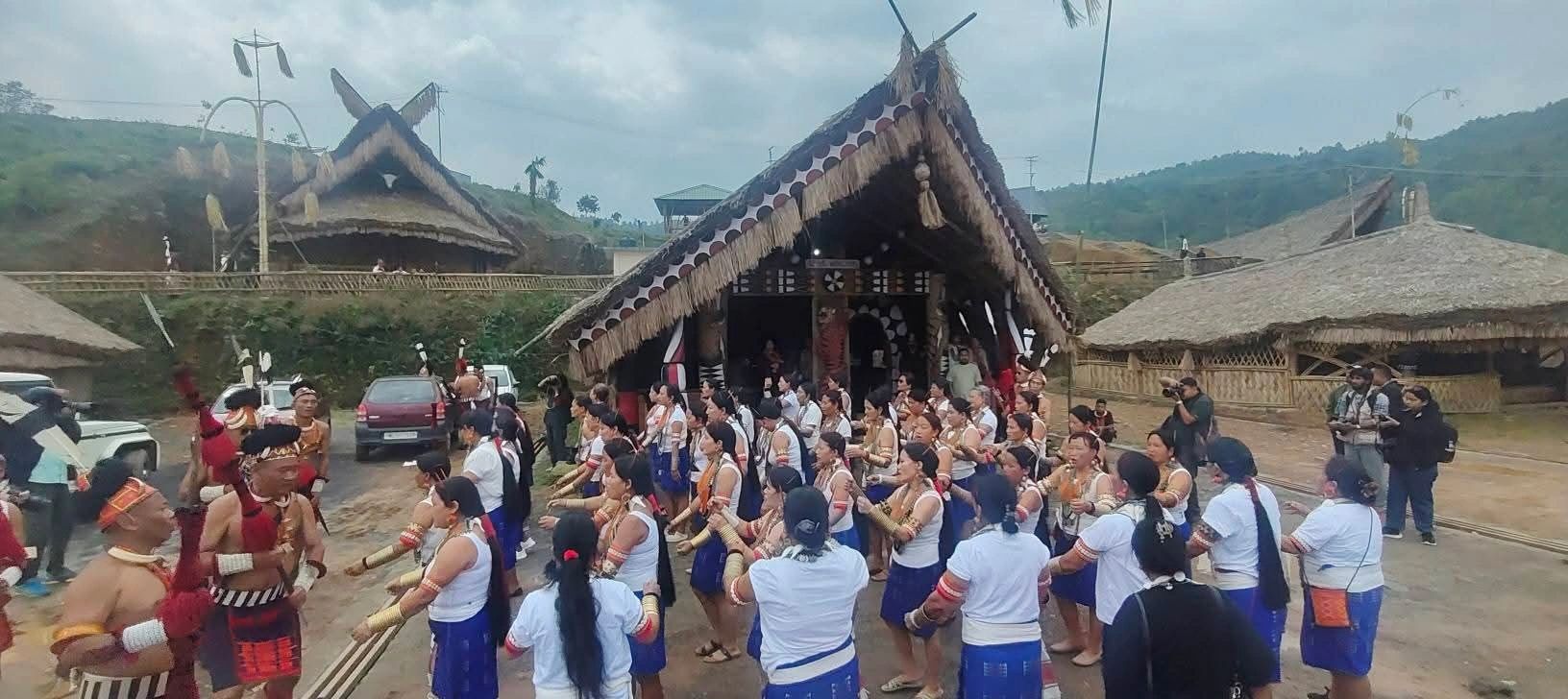
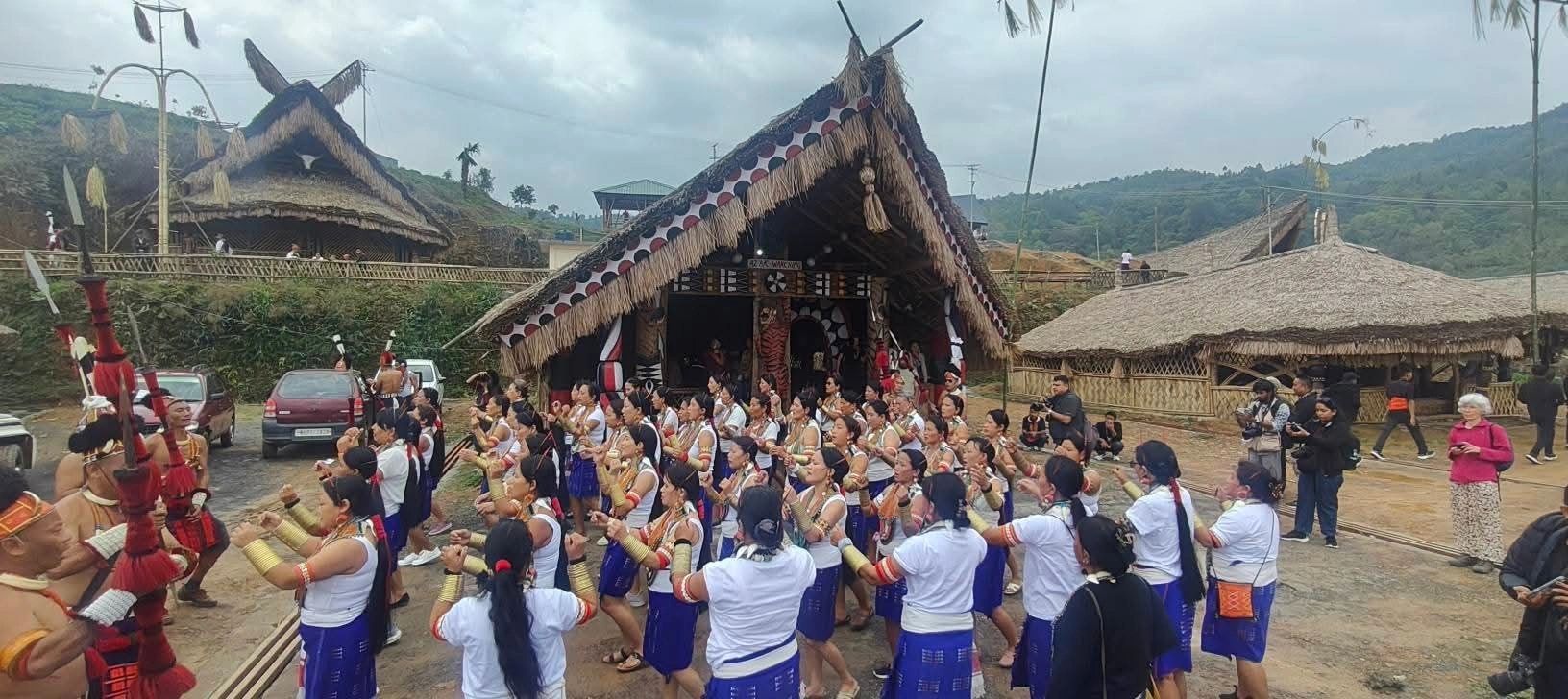
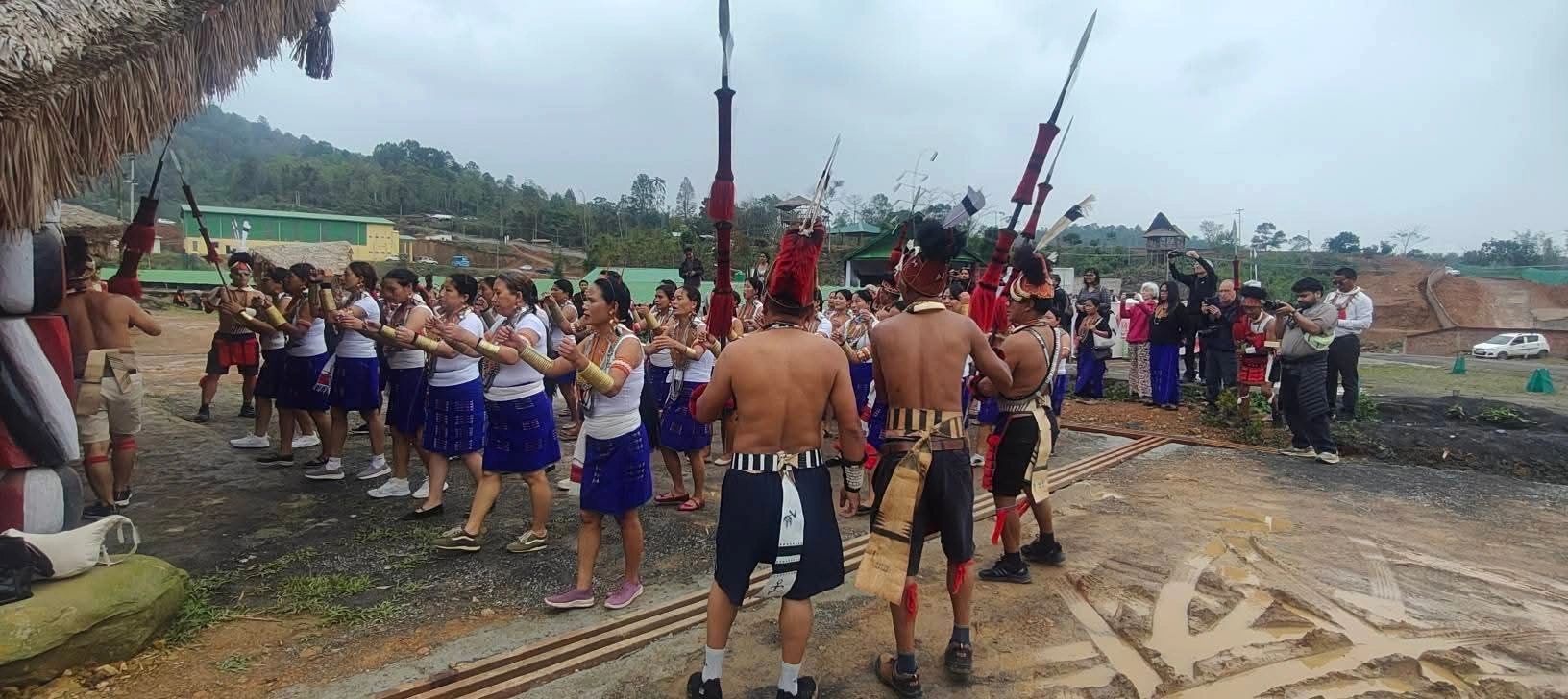
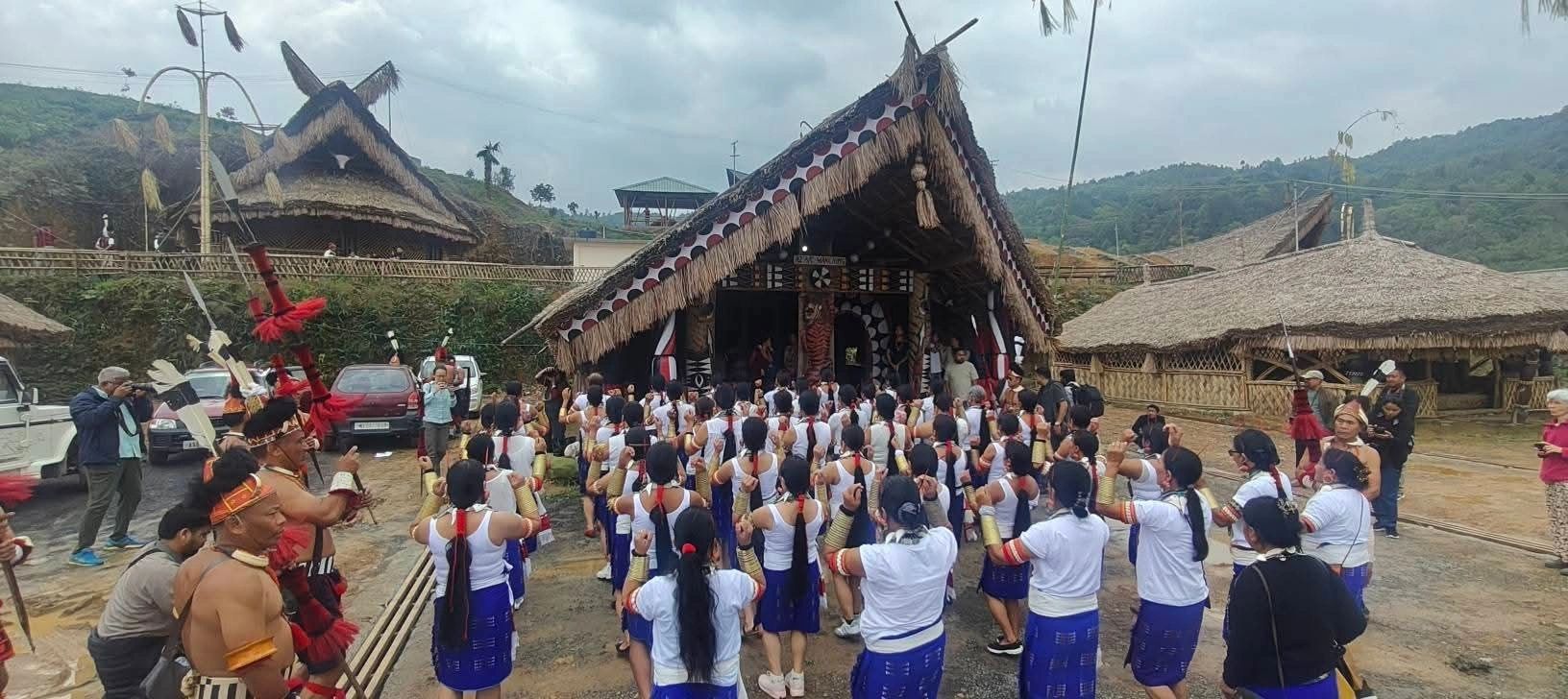
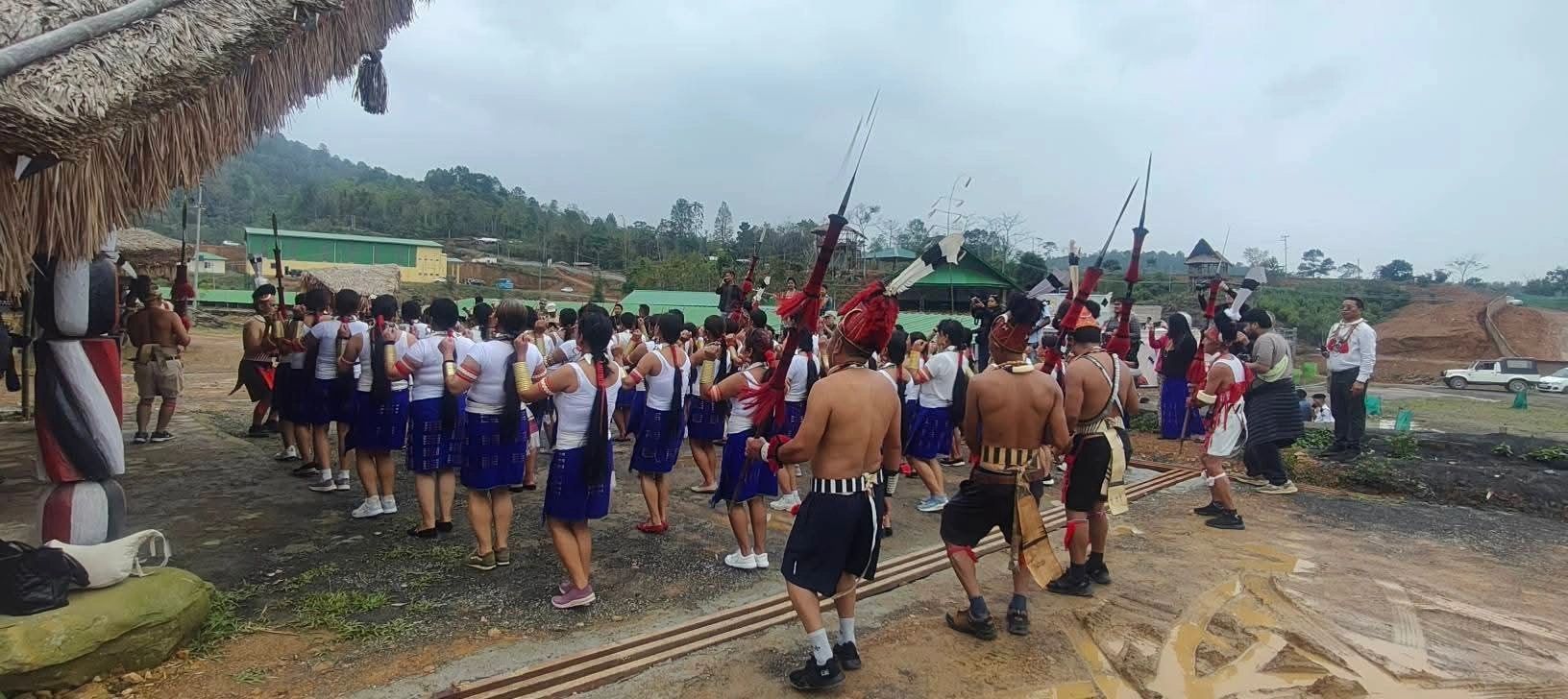
Out in the villages it is quieter and far better. The morning we spent in a village above Mon began with smoke rising through thatch, women cutting pork in the courtyard, and a boy of about nine practising his father's dance step in the mud with total seriousness. By ten the ground in front of the morung was full: two lines of women in indigo wrap-skirts and white blouses, brass and cane rings stacked from wrist to elbow, moving forward and back in a step that is almost a walk until you try to copy it.
The men come in behind them, spears up, hornbill-feather headgear nodding, and the noise arrives all at once — the drum, the stamped rhythm, a shouted call, and answering shouts from the far end of the line.
It is not staged for you. Tourists were present at every celebration we attended, cameras and all, but we were guests standing at the edge of somebody's New Year, not an audience.
Traditional attire and ornaments
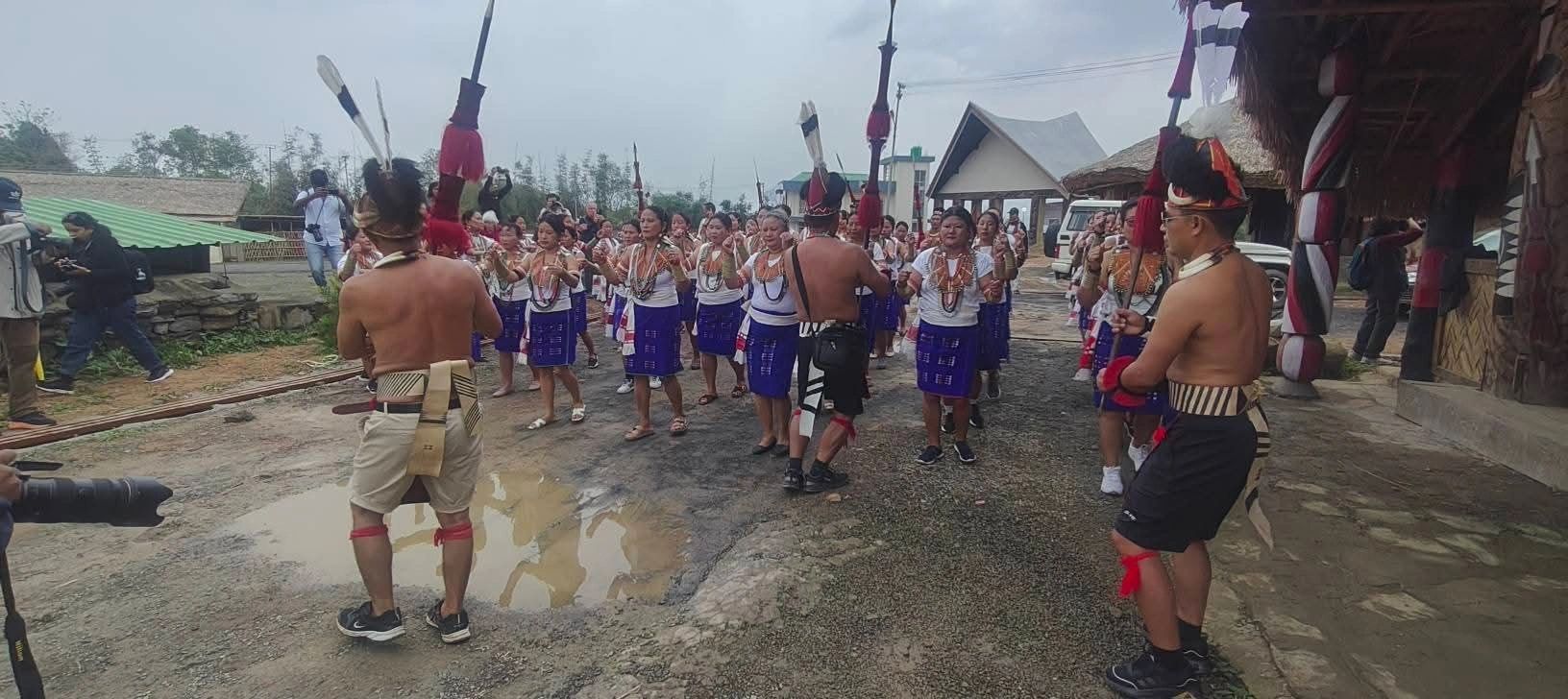
Aoleang is when the boxes come out. What a Konyak wears at this festival is a readable document — clan, status, marriage, and in the case of the oldest men, deeds nobody performs any more.
The women wear a deep-blue or indigo wrap-skirt woven with fine bands, a white or coloured top, and enormous stacked cane and brass arm rings polished for the occasion. Necklaces are layered: glass beads, cowrie shells, carnelian and old trade beads that came up these hills through Assam a century ago. Many women wear a small woven bag over the shoulder that has never been to a market.
The men's dress is heavier and louder. Red-dyed goat hair on the headgear, hornbill feathers where they are permitted, boar tusks curving from the neck, cowries stitched to a shoulder baldric, a dao at the belt and a spear in the hand. The elders carry the two things you cannot buy: facial and chest tattoos taken at initiation, and a brass head pendant on a cord — once earned, one bead per head taken.
Photograph these men with permission and, ideally, with someone who can introduce you. They are in their eighties and nineties. There will not be another generation of them.
Music, dances and celebrations
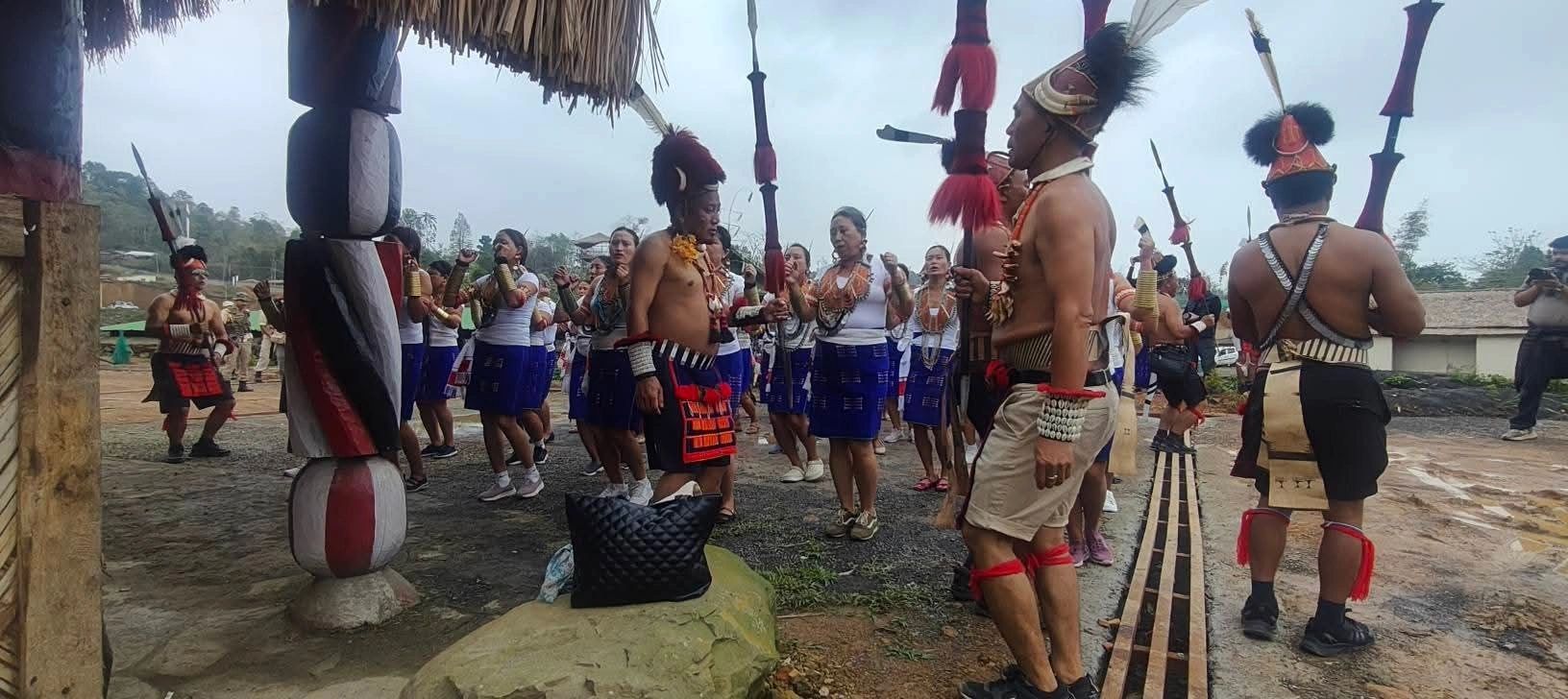
The log drum is the heart of it. Carved from a single trunk and housed in its own shed near the morung, it was historically the village's telegraph — coded beats for a raid, a death, a fire, a return. At Aoleang it is played for joy, and the rhythm is deliberately simple so that everybody can move to it.
Around it: bamboo mouth harps, a buffalo-horn trumpet that sounds like a ship, hand-clapping and, above all, singing. Konyak festival songs are call-and-response, unaccompanied, and pitched low. They are also frequently funny — many are teasing exchanges between the men's line and the women's line, and the crowd's laughter tells you when a good one has landed even if you have no idea what was said.
Traditional games fill the afternoons — wrestling, high jump over a bamboo bar, target shooting with a catapult or an air rifle, tug of war between morungs. Evenings turn to courtship songs and, in many villages now, a gospel choir performance that is every bit as full-throated as the drum.
Food and community feasts
On Yin Mok Nyih, the third day, animals are killed and the meat is divided — not sold, divided — so that every household in the village receives a share, including families with no one to hunt or slaughter. Watching that distribution is one of the more affecting things you can do at Aoleang.
The food itself is direct. Smoked pork with bamboo shoot and dried chilli. Pork with axone, fermented soybean, whose smell arrives well before the bowl. Boiled greens, colocasia leaves, yam, sticky rice steamed in leaves. Anishi in Ao country to the west, but here more often plain rice and a searing chutney of raja mircha, the king chilli, which you should treat with real respect.
Rice beer is brewed for days beforehand and served in bamboo mugs or a gourd. It is weak, cloudy and constant. In Christian households you may instead be handed sweet black tea and biscuits with exactly the same insistence. Take a little of whatever comes. Refusing outright reads as a rebuke.
Photography moments — and how to earn them
Mon in April is technically difficult and visually extraordinary. The light is hazy from field-burning, the ground is dark, the costumes are saturated red and indigo, and the action is fast and close.
Practical notes from our own frames: shoot the morning light before 9am and again after 4pm, keep a wide lens on the body for the dance lines and a fast 85mm or 135mm for elder portraits, expect to work at ISO 1600 inside a morung, and bring twice the battery you think you need because charging in a village homestay is a negotiation with a generator.
The pictures that matter are not the ones of headgear. They are the hands — brass rings, a knife, a child's fingers in a grandmother's beads — and the faces of people watching their own festival.
Always ask. A folded-hands gesture and a raised camera is understood everywhere in Mon. If someone says no, that is a complete sentence. Paying for portraits is common in Longwa and increasingly expected; agree the amount before you shoot, not after.
Respecting local traditions
Mon district is not a hard place to visit, but it is easy to be rude in it without meaning to be.
Greet the Angh, the hereditary chief, before you photograph anything in his village — your guide will manage this, and it takes five minutes. Do not enter a morung uninvited; some sections are restricted, and human skulls or their replicas are still kept in a few of them. Dress plainly. Sunday is church, and most villages will not dance on it.
Do not use the word 'headhunter' to somebody's face as a description. The elders are proud men with tattoos they earned inside a system that no longer exists, and they are also grandfathers, deacons and farmers.
And if a family invites you into their kitchen, sit down. That invitation is the actual experience; the dance is only what brought you there.
Why Aoleang is one of India's most authentic cultural festivals
India has no shortage of spectacular festivals. It has very few where the celebration has not yet been reorganised around the visitor.
Aoleang is one of them. There is no ticket, no seating plan, no compere, no stage. The dance happens in the village it has always happened in, on the days the village decides, whether forty photographers turn up or none. The people in the line are not performers; they are the neighbours, cousins and schoolteachers of the people watching.
Compared with the Hornbill Festival — which we recommend without reservation for what it is — Aoleang gives you something Hornbill structurally cannot: one village, one week, one community's own new year, seen from inside. Among the traditional festivals of India and the cultural festivals of Northeast India, that is now genuinely rare.
Travel tips for visiting Mon
Book everything early. Mon town has a small number of guesthouses and they fill by February for the first week of April; village homestays in Longwa, Shangnyu and Hongphoi are limited to a handful of rooms each and are best arranged through an operator who knows the households.
Carry cash. ATMs in Mon town exist and regularly run dry during the festival; there is nothing usable in the villages.
Expect basics, not comfort. Homestays mean a mattress, a bucket bath, shared toilets and evening power at best. Network is patchy — BSNL and Jio work in parts of Mon town, barely elsewhere.
Pack for both extremes: hot hazy afternoons, cold nights at 1,200–1,600 m, dust, and one unexpected pre-monsoon downpour. Shoes with grip; the village paths are steep and slick.
Take a local guide. Not for translation alone — for the introductions that turn a photo stop into a day in someone's house.
- Permits: Indian visitors need an Inner Line Permit (ILP) for Nagaland; foreign nationals must register at the Foreigners Registration Office and, under the Protected Area regime reimposed in December 2024, hold a Protected Area Permit arranged in advance.
- Longwa: the chief's house sits astride the India–Myanmar border; carry ID, and do not wander across the line.
- Alcohol: Nagaland is officially dry. Rice beer in villages is customary; do not carry bottles in.
- Health: nearest reliable hospital care is in Dibrugarh or Sonari, several hours away. Carry a basic kit.
How to reach Mon
Mon is the far north-eastern corner of Nagaland, and the fastest way in is not through Nagaland at all — it is through Assam.
By air: fly to Dibrugarh (Mohanbari, DIB), then drive roughly 5–6 hours via Sonari to Mon town — the shortest and most reliable approach. Jorhat (JRH) is an alternative at around 7 hours. Dimapur (DMU) is the main Nagaland airport but is 10–12 hours away by road.
By rail: Simaluguri and Sonari in Assam are the closest useful railheads, with taxis onward to Mon in about 3–4 hours.
By road within Nagaland: Kohima to Mon is a long, hard 12–14 hours, and Mokokchung to Mon roughly 6–7 hours on a rough but scenic route through Ao and Konyak country. Drive daylight hours only.
From Mon town, the villages are 30 minutes to 2.5 hours further on rough roads — Longwa about 42 km and 2–2.5 hours, Shangnyu around 1.5 hours, Chui and Hongphoi closer. A hired 4x4 with a local driver is the only sensible arrangement in the first week of April.
Best time to visit
For the festival: 1–6 April, every year, with the fourth and fifth days generally the fullest for dancing and feasting. Arrive on 31 March or 1 April to settle in, and give yourself at least three nights.
For Mon generally: October to April. November to February is cool, clear and quiet, and the best window for elder portraits and village walks without festival crowds. Avoid mid-June to September, when the monsoon takes out the Sonari–Mon road with landslides.
If you want to combine, the Hornbill Festival runs 1–10 December near Kohima at the other end of the state, and pairs naturally with a slower Konyak leg afterwards.
Responsible tourism in Konyak country
Money should stay in the village. Choose a community homestay over a town hotel where you can, eat what the household cooks, hire local drivers and guides, and buy directly from weavers and blacksmiths rather than from a curio shop on the highway.
Do not buy anything made from hornbill casque, tiger, bear or elephant. It is illegal under the Wildlife Protection Act, and the trade is a real pressure on species the Konyak themselves are now working to protect through village hunting bans.
Ask before photographing children, and never hand out sweets or money to them. If you promise to send prints — and you should — actually send them. Half the goodwill visitors enjoy in Mon today was built by photographers who kept that promise, and half the suspicion by those who did not.
Keep group sizes small. Six people in a village at Aoleang is a guest party. Twenty-six is an event.
Final reflections
On our last evening the dancing had thinned out and most people had gone home to eat. An old man in a faded jacket sat on the log-drum shed's step with a cigarette, watching two teenagers argue over a phone. He had a brass pendant on a cord around his neck and a line of tattoo across his face.
We asked our guide what he was saying. 'He says the drum sounds the same,' came the answer. 'Everything else is different, but the drum sounds the same.'
That is Aoleang. It is not a preserved thing and it is not a performance. It is a community, changed enormously in one lifetime, choosing every April to do this again — and letting a few of us stand at the edge of it with our cameras down for at least part of the day.
Go while the old men are still there. Go small, go slowly, and stay for the meal.
Essential travel information
- Getting there
- Fly Dibrugarh (DIB), drive via Sonari to Mon (5–6 hrs). Jorhat 7 hrs, Dimapur 10–12 hrs.
- Stay
- Guesthouses in Mon town; village homestays in Longwa, Shangnyu and Hongphoi. Book by February.
- Getting around
- Hired 4x4 with local driver. Longwa is 42 km / 2–2.5 hrs from Mon town.
- Money
- Carry cash — Mon ATMs run dry during the festival and villages have none.
- Connectivity
- Patchy BSNL/Jio in Mon town; effectively none in most villages.
- Weather in April
- Hazy 28–32°C days, 14–18°C nights, occasional pre-monsoon storms.
- Health
- Nearest reliable hospitals are in Sonari or Dibrugarh. Carry a personal medical kit.
Did you know?
- The Konyak are the largest Naga tribe in Nagaland and live on both sides of the India–Myanmar border; the chief's house in Longwa village literally straddles the international boundary.
- A Konyak village is headed by an Angh, a hereditary chief whose authority once extended over dozens of villages and whose lineage traditionally practised polygamy to bind clans together.
- Facial and chest tattoos were awarded, not chosen — each design recorded a specific achievement, and the artists were traditionally women of a particular clan.
- The brass head pendants worn by the oldest men are counters: one small brass face for each head taken, in an era that ended in living memory.
- The Konyak are among the finest metalworkers in the Naga hills and still forge their own daos, gun barrels and brass ornaments in village smithies.
- The log drum, carved from a single tree, was the village's communication system — distinct beat patterns announced war, fire, death and celebration across valleys.
- Nearly the entire community converted to Christianity within about two generations, one of the fastest religious transitions recorded anywhere in India.
Frequently asked questions
- What is the Aoleang Festival?
- Aoleang Monyu is the Konyak New Year festival, celebrated across Mon district in Nagaland from 1 to 6 April each year. It marks the end of the old agricultural cycle and the start of spring sowing, with six named days of feasting, log-drum music, dance and rituals centred on each village's morung.
- When is Aoleang Festival celebrated in 2026?
- Aoleang is celebrated on fixed dates — 1 to 6 April — every year, including 2026. The main feasting and dancing usually fall on the fourth and fifth days, so plan to be in Mon district from 1 April and stay at least three nights.
- Where does the Aoleang Festival take place?
- In Konyak villages throughout Mon district, eastern Nagaland — including Longwa, Shangnyu, Chui, Hongphoi, Wakching and Mon town itself. Unlike the Hornbill Festival there is no single venue; each village celebrates on its own ground in front of its morung.
- How do I reach Mon for the Aoleang Festival?
- The fastest route is to fly to Dibrugarh airport in Assam and drive 5–6 hours via Sonari to Mon town. Jorhat is around 7 hours and Dimapur 10–12 hours. From Mon town, villages such as Longwa are a further 2–2.5 hours on rough roads, best covered in a hired 4x4 with a local driver.
- Do I need a permit to visit Mon district in Nagaland?
- Yes. Indian nationals need an Inner Line Permit (ILP) for Nagaland, available online or from the deputy commissioner's office. Foreign nationals must register with the Foreigners Registration Office on arrival and, under the Protected Area regime reimposed in December 2024, hold a Protected Area Permit arranged in advance through a registered operator.
- Is the Aoleang Festival open to tourists, and is there an entry fee?
- It is open to visitors and there is no ticket or entry fee — it is a community celebration, not a staged event. You attend as a guest of a village, which is why coming with a local guide or homestay host who can introduce you to the Angh makes an enormous difference.
- Can I photograph Konyak elders at Aoleang?
- Yes, with permission. Ask before every portrait, ideally through a guide or host. Payment for portraits is common in villages like Longwa and should be agreed beforehand. Avoid entering a morung uninvited and never photograph restricted interiors or children without a parent's consent.
- How is Aoleang different from the Hornbill Festival?
- Hornbill is a state-organised tourism festival held at Kisama near Kohima from 1 to 10 December, showcasing all Naga tribes on a purpose-built site. Aoleang is a single tribe's own new year, celebrated in April in the villages where people actually live, with no stage, programme or ticket.
Photo gallery — from the same trip
More from the journal
Among the Monpa: Thembang, Sangti Valley and Dirang Dzong
Stone houses, inscribed mithun skulls, yak meat drying in the winter sun — three days in the Monpa heartland of West Kameng, Arunachal Pradesh.
Majuli Island, Assam — crossing the Brahmaputra to a river island
The ferry ghat, an hour on the Brahmaputra, and then paddy fields — notes from Majuli, the river island at the heart of Assam's Vaishnavite culture.