Nagaland · Mon district · Konyak
The Headhunters of Nagaland
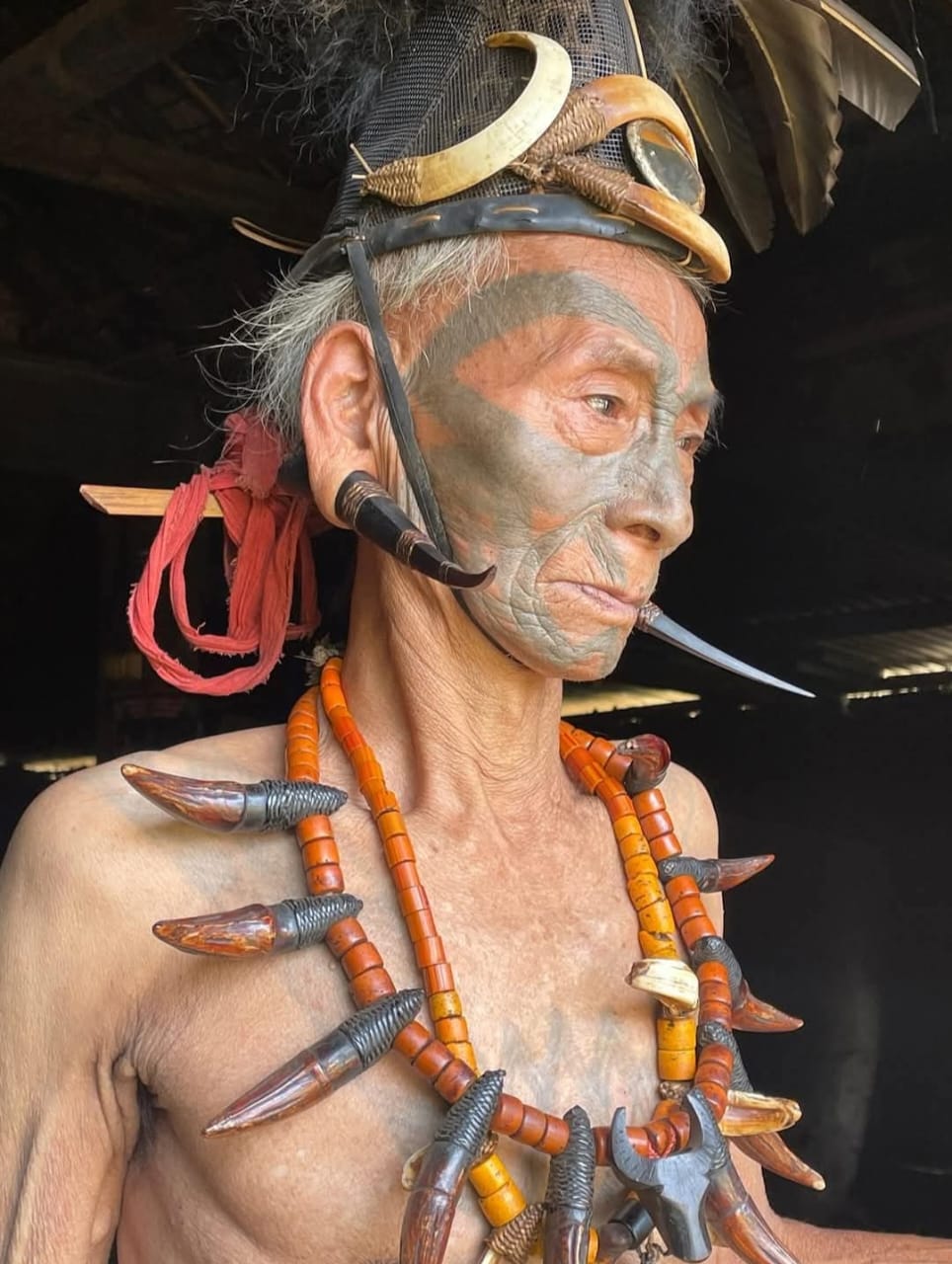
In the hills of Mon district in eastern Nagaland, a handful of very old Konyak men still carry the facial tattoos that were once earned only by taking a head in war. They are the last living link to an institution that ended within living memory. This is an accurate, field-based guide to who they are, what headhunting actually meant, and how to visit their villages without turning them into a spectacle.
Video from the field
Original footage filmed by our own team in the Konyak belt. We publish our own material rather than licensed stock so that what you see on this page is what you will actually meet on the ground.
Who the Konyak are
The Konyak are the largest of Nagaland's recognised tribes, concentrated in Mon district in the state's far east, with related communities across the international boundary in Myanmar's Sagaing Region and to the north in Arunachal Pradesh. Their society is unusual among the Naga tribes for being strongly hierarchical: villages are led by a hereditary chief, the Angh, whose authority historically extended over a cluster of tributary villages. The great Anghs practised polygyny to bind allied villages to the line, and their households remain the ceremonial centre of village life.
The Konyak language belongs to the Northern Naga (Konyak–Wancho–Nocte) group within Tibeto-Burman. Because dialects change from ridge to ridge, Nagamese — an Assamese-based contact language — is the practical lingua franca across the district, with English used in schools, churches and government.
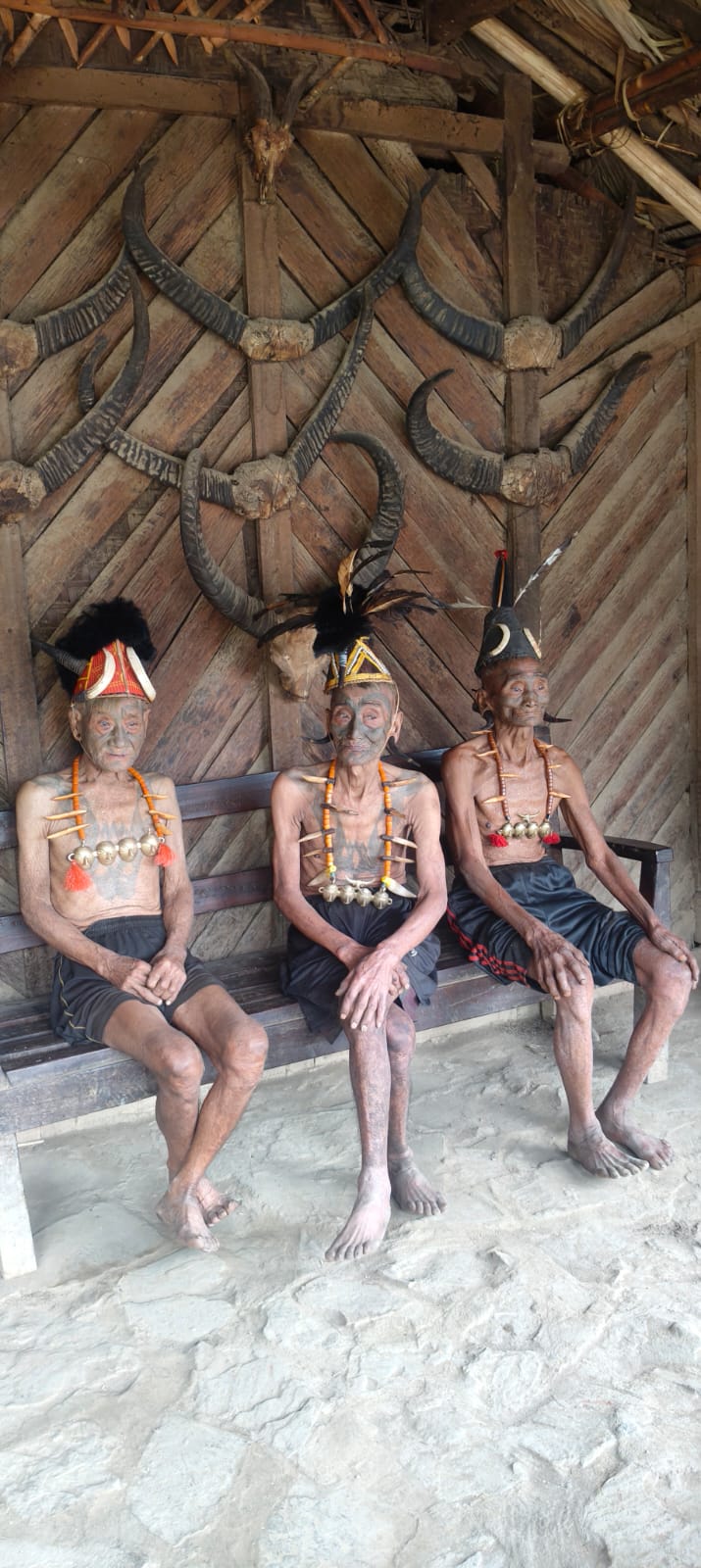
Konyak villages are usually built along the crest of a ridge, defensively sited, with the morung (the bachelors' dormitory and men's institution) at their heart. The morung was where boys learned discipline, oral history, woodcarving, warfare and the songs of the village, and where the great hollowed log drum was kept and beaten to mark raids, deaths and festivals. Most morungs today are cultural rather than military institutions, and many have been rebuilt in concrete; a few — including at Longwa and Shangnyu — retain the old carved posts, hornbill imagery and mithun skulls.
What headhunting actually was
Headhunting among the Naga tribes was not indiscriminate violence. It was a ritual economy built on a belief in a soul-force or life-essence — often described in the ethnographic literature as residing in the head — that could be captured and brought home to benefit the whole community. A successful raid was believed to bring fertility to the fields, health to the village and prosperity to the clan. The taken heads were installed in the morung or on the head-tree, and were fed and honoured in ceremony.
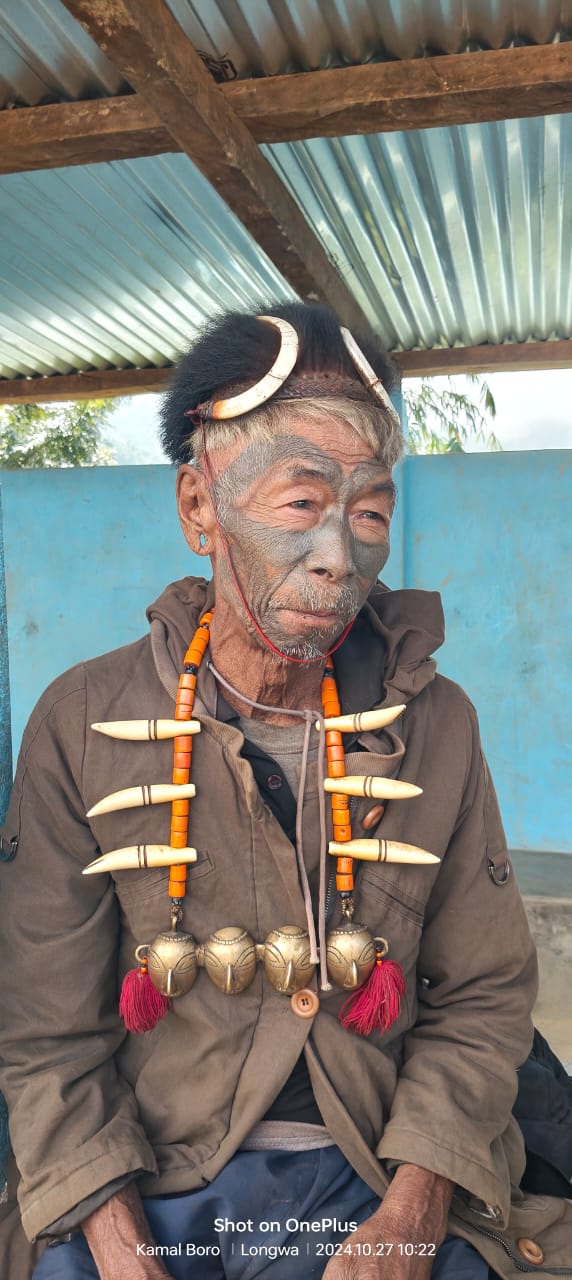
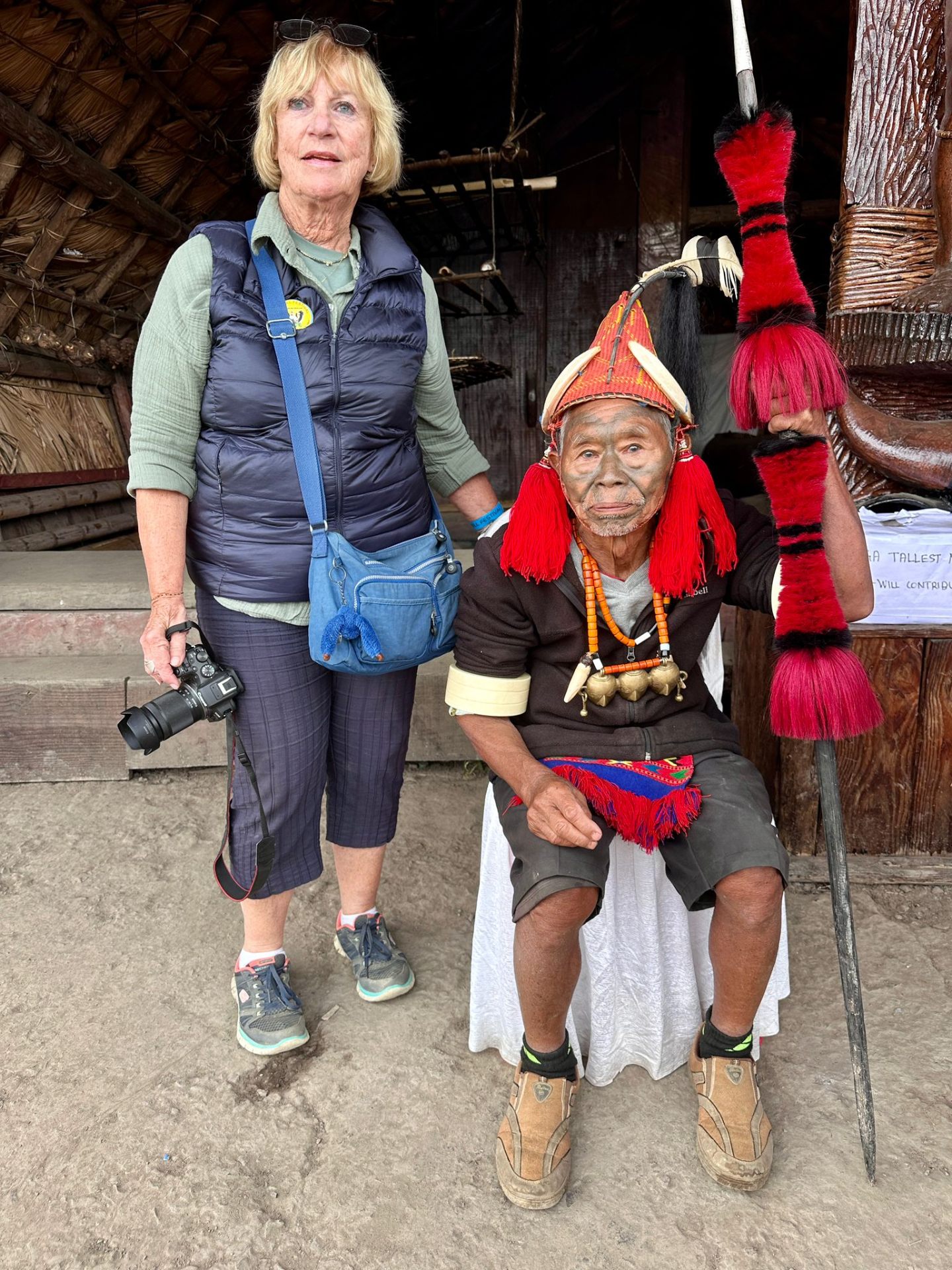
For the individual warrior, the reward was social. Only a man who had taken a head could receive the full facial tattoo, applied by the village's hereditary women tattooists using thorn or iron points and a pigment of soot and plant resin. Different villages used different designs, and additional chest, throat and arm work marked further honours. Brass pendants shaped like small heads, worn on a bead necklace, recorded how many heads a man had taken. Boar tusks, hornbill feathers, wild-goat hair and tiger claws in the headdress were similarly earned, not bought.
Raids were governed by rules of feud, alliance and season, and were usually directed at specific rival villages rather than passing strangers. British colonial administration in the Naga Hills suppressed the practice progressively from the late nineteenth century, formally prohibiting it in the 1930s, but Mon lay at the far edge of that administration — much of the Konyak belt was classed as unadministered territory well into the twentieth century, which is precisely why the tradition survived there longest.
The decisive change was religious. American Baptist mission work, which had begun among the Ao in the 1870s, reached the Konyak areas seriously in the 1940s and 1950s. Within two generations the great majority of Konyaks became Baptist Christians, the head-trophies were surrendered or buried, and the ritual logic that made head-taking meaningful dissolved. Isolated incidents continued into the 1960s; local historians most often cite 1969 as the last recorded case in the Konyak area. Nagaland itself became India's sixteenth state on 1 December 1963.
The last generation
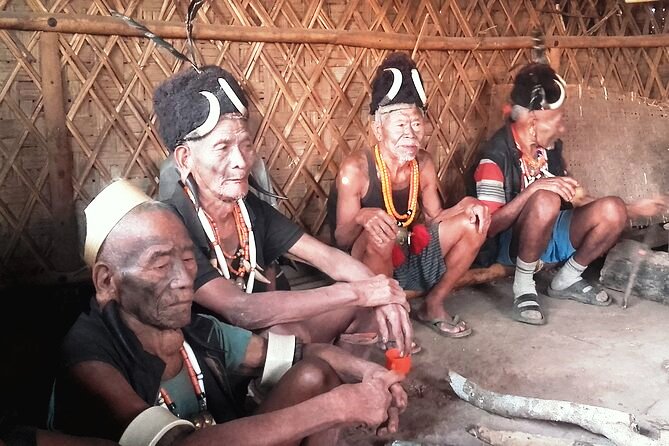
The men you can still meet were young in the 1940s, 50s and early 60s. Some took part in raids; many more grew up inside the culture that surrounded them, were tattooed as young men, and remember the log drum being beaten. They are now overwhelmingly in their late eighties and nineties, and the number falls every year — a fact acknowledged openly in Mon, where each death is reported as the passing of a living archive.
This creates an obvious tension. The tattooed elder has become the single most photographed subject in Northeast India, and in the most-visited villages a steady stream of photographers arrives with telephoto lenses and a shot list. The elders are usually gracious about it. That does not make it neutral. The single best thing a visitor can do is slow down: sit, share tea, use an interpreter, ask about the village rather than the killing, and pay properly for the portrait.
Aoleang Monyu — the festival to plan around
Aoleang Monyu is the greatest Konyak festival, celebrated in the first week of April — most commonly 1 to 6 April — to mark the new year and the start of the sowing season after the fields have been cleared and burned. It is a spring festival of renewal: new clothes and full ceremonial dress, the killing of pigs and mithun, feasting between clans, the singing of Aoleang songs, courtship between young men and women, and the formal blessing of the coming harvest by the Angh.
Each of the six days carries its own name and function in the traditional reckoning, from the day of collecting firewood and leaves, through the day of slaughter and feasting, to the closing day of reconciliation. Longwa, Mon town, Chui, Shangnyu and Hongphoi are all strong places to be during Aoleang, and Mon town hosts a district-level celebration. Accommodation in Mon sells out; book several months ahead.
The Konyak also appear at the Hornbill Festival at Kisama near Kohima each 1–10 December, where they maintain their own morung. That is a good introduction, but it is a curated stage; Mon is the real thing. In the Arunachal borderlands, the Nocte celebrate Chalo Loku and the Wancho Oriah, both rooted in the same cultural world.
Where to go — villages worth your time
Longwa
Mon, Nagaland
The most visited Konyak village in India. The Angh's longhouse sits astride the India–Myanmar boundary — the chief's residence is famously described as half in Nagaland and half in Myanmar's Sagaing Region. Several tattooed elders still live here, along with gunsmiths and opium-related social problems the community openly discusses.
- Getting there
- 42 km from Mon town, roughly 2–2.5 hours by shared Sumo or hired 4x4 on a rough hill road.
- Where to stay
- Community and family homestays in the village (basic, shared bathroom, wood fire); most travellers base in Mon town and day-trip.
Shangnyu
Mon, Nagaland
Home to a large carved wooden monolith in the Angh's compound, one of the most important surviving pieces of Konyak wood sculpture. The village is a seat of a powerful Angh lineage and holds strong morung traditions.
- Getting there
- About 35 km from Mon town, 1.5–2 hours by road.
- Where to stay
- Day visit from Mon; simple homestays can be arranged in advance through the village council.
Hongphoi (Hongphui)
Mon, Nagaland
A quieter alternative to Longwa with tattooed elders, log drums and traditional thatched Konyak houses. Fewer vehicles arrive here, so portrait and documentary photography is calmer and more consensual.
- Getting there
- Roughly 40 km north-east of Mon town on the border road.
- Where to stay
- Homestay bookings through the village GB (Gaonbura) or a Mon-based operator.
Chui (Chui Konyak)
Mon, Nagaland
One of the oldest Konyak settlements near Mon, known for its Angh's house, carved house-fronts, log drum and view over the Mon ridge. Good first stop for understanding Konyak village hierarchy.
- Getting there
- About 15 km from Mon town, under an hour.
- Where to stay
- Day visit; stay in Mon town.
Mon town
Mon, Nagaland
The district headquarters and the practical base for the whole Konyak belt — ATMs, fuel, mobile network, the district hospital, the Sunday market and access roads to every major village.
- Getting there
- Gateway town; 4–5 hours from Sonari (Assam), 8–9 hours from Dibrugarh, 10–12 hours from Kohima.
- Where to stay
- Konyak Tea Retreat, Helsa Cottage, Paramount Guest House and several small lodges.
Wakching
Mon, Nagaland
A historically important Konyak village documented by early anthropologists, including Christoph von Fürer-Haimendorf in the 1930s. Useful for travellers interested in the ethnographic record rather than only photography.
- Getting there
- About 45 km from Mon town on the Wakching road.
- Where to stay
- Day visit from Mon; limited local guest rooms.
Longding & Kanubari (Wancho belt)
Longding, Arunachal Pradesh
The Wancho are close cultural cousins of the Konyak and also practised headhunting until the mid-20th century. Tattooed Wancho elders, Angh houses and log-drum houses survive around Longding, Wakka, Niausa and Kanubari.
- Getting there
- Longding is roughly 6–7 hours from Dibrugarh via Namsai/Deomali, or a long day's drive from Mon.
- Where to stay
- Circuit House and small guest houses at Longding and Deomali; homestays at Wakka.
Borduria & Namsang (Nocte belt)
Tirap, Arunachal Pradesh
Nocte villages with hereditary chiefs, ceremonial gates and the Chalo Loku festival. Elders here also carry the memory of head-taking and the ritual system that surrounded it.
- Getting there
- 20–30 km from Khonsa; Khonsa is 5–6 hours from Dibrugarh.
- Where to stay
- Khonsa Circuit House and guest houses; community homestays in Borduria.
Full research pages for many of these settlements sit in our tribal villages encyclopedia.
How to reach Mon district
By air. Dibrugarh (DIB) in Upper Assam is the most useful airport — around 8–9 hours of total driving to Mon, best broken at Sonari or Sivasagar. Jorhat (JRH) is a similar alternative. Dimapur (DMU), Nagaland's own airport, is 10–12 hours from Mon by road via Kohima and Mokokchung and only makes sense if you are combining Mon with the Hornbill Festival.
By rail. The nearest useful railheads are Simaluguri and Sivasagar in Assam, and Dimapur inside Nagaland. Simaluguri to Mon via Sonari is roughly 5–6 hours by road.
By road. Entry to Mon district from Assam is via Sonari and the Naginimora or Tizit checkposts. Roads inside the district are hill roads in variable condition and slow after rain; budget 20–25 km/h on village routes and use a 4x4 with a driver who knows the ridge. Shared Tata Sumo services run Sonari–Mon and Mon–Longwa daily, usually departing early morning.
Best time. October to April. The first week of April for Aoleang Monyu; December if you are pairing Mon with Hornbill. Avoid the June–September monsoon, when landslides regularly close the approach roads.
Where to stay
Mon town is the base. Konyak Tea Retreat is the best-known comfortable option, built in Konyak style on a tea slope outside town. Helsa Cottage and Paramount Guest House are simpler in-town choices used by most tour groups, and the government Circuit House can sometimes be booked through the district administration. Expect basic rooms, intermittent power, limited hot water and no ATMs you should rely on — carry cash from Sonari or Dibrugarh.
Village homestays at Longwa and Hongphoi are the more meaningful choice if you can accept the conditions: a room in a family house, a wood-fire kitchen, shared washing, and evenings spent talking rather than online. Homestays put money directly into the village economy. They must be arranged in advance through the village council, a Gaonbura, or an operator based in Nagaland — turning up unannounced is not appropriate in a hierarchical village.
During Aoleang Monyu in early April and during the Hornbill Festival window in December, everything in Mon is full months ahead. Plan accordingly.
A realistic six-day itinerary
Day 1
Fly into Dibrugarh (DIB). Drive to Sonari or Sivasagar in Upper Assam (2–3 hours), overnight in a tea-estate bungalow or hotel. This shortens the next day's hill drive considerably.
Day 2
Cross into Nagaland at Naginimora / Tizit, complete ILP or PAP checks, and continue to Mon town (4–5 hours). Afternoon walk through Mon bazaar and Chui village to meet your first Konyak elders.
Day 3
Full day at Longwa — the Angh's longhouse on the international boundary, the morung, gunsmiths, and time with tattooed elders. Return to Mon in the evening.
Day 4
Shangnyu for the carved monolith and Angh's compound, then Hongphoi for quieter portrait sessions and the log drum. Overnight Mon.
Day 5
Optional crossing to Arunachal Pradesh's Longding or Tirap belt for the Wancho and Nocte villages, or drive back to Sonari and Jorhat for Majuli and the Assam leg.
Day 6
Drive out to Dibrugarh or Jorhat for the return flight. Travellers combining this with the Hornbill Festival continue south to Kohima instead (10–12 hours from Mon).
Permits: what you legally need
Indian citizens need an Inner Line Permit (ILP) for Nagaland, issued online through the state portal or at Dimapur and Kohima, typically ₹100–₹200. Keep printed copies — it is checked at the district boundary.
Foreign nationals need a Protected Area Permit (PAP). The Ministry of Home Affairs reimposed the Protected Area Regime on Nagaland, Manipur and Mizoram by circular dated 17 December 2024, cancelling the relaxation that had applied since 2010. Apply 4–6 weeks in advance through a registered Indian tour operator, and register at the Foreigners Registration Office in Mon, Kohima or Dimapur within 24 hours of arrival. Citizens of Pakistan, Afghanistan and China require prior MHA clearance.
If you plan to continue into the Wancho and Nocte belt in Arunachal Pradesh, that is a separate permit: ILP for Indians and PAP for foreigners, issued by Arunachal Pradesh. Full details are on our Northeast India permits guide.
Photography & visiting etiquette
- Always ask before photographing an elder, and accept a refusal. Many tattooed men are in their 80s and 90s and are photographed constantly.
- Agree any photography contribution in advance and hand it to the person, not to an intermediary. A modest cash gift, tea, sugar or medicines are all appreciated.
- The tattoos are war honours, not costume. Do not ask elders to 'pose as headhunters' or handle their skulls, weapons or brass head-trophy necklaces without permission.
- Ask before entering a morung or an Angh's house; some structures are ritually restricted and shoes come off at the threshold.
- Drone flying near the international boundary at Longwa is a security matter — do not fly without the village council's consent and local police advice.
- Do not buy or attempt to export human remains, tiger or hornbill parts, or antique firearms. Wildlife-derived souvenirs are illegal under Indian law.
- Alcohol is officially prohibited in Nagaland under the Nagaland Liquor Total Prohibition Act, 1989; do not bring it as a gift.
- Opium (kani) dependency is a real issue in parts of Mon district. Discuss it sensitively; do not photograph users for shock value.
Food, crafts and what to bring home
Konyak food is smoky and fermented: pork with bamboo shoot, smoked and dried meats hung above the hearth, axone-style fermented soybean, boiled greens, sticky rice and the fierce local king chilli. Rice beer is traditional though officially restricted by state prohibition. Meals in homestays are communal and generous; vegetarians should give notice in advance because it takes planning.
Craft to buy directly from makers includes back-strap loom shawls and wraps with clan-specific bands, machetes (dao) and their woven scabbards, cane and bamboo baskets, wooden masks and figures, and beadwork. Buy from the household that made it rather than from a roadside reseller. Do not buy anything containing hornbill casque, tiger parts or human remains — those are illegal to purchase and to export.
Frequently asked questions
Who were the headhunters of Nagaland?
They were warriors from several Naga tribes — most famously the Konyak of Mon district, and also the Wancho and Nocte across the border in Arunachal Pradesh — who took the heads of enemies in inter-village raids. Head-taking was a ritual and social institution rather than random violence: heads were believed to carry a life-force that brought fertility to fields, prosperity to the village and status to the warrior, who earned facial and chest tattoos and the right to wear brass head pendants.
When did headhunting stop in Nagaland?
It was progressively suppressed under British administration from the late 19th century, banned outright in the Naga Hills in the 1930s, and largely ended after the Second World War as American Baptist mission work and Christian conversion spread through the Konyak areas in the 1940s and 1950s. Remote pockets of Mon district continued longer; the last incidents in the Konyak belt are generally dated to the 1960s, with 1969 the year most commonly cited by local historians for the last recorded case.
Are there still living headhunters today?
A small and rapidly shrinking number of very elderly Konyak, Wancho and Nocte men who took part in raids as young men are still alive, mostly in their late 80s and 90s. Every year fewer remain. Many more elders carry the tattoos and ornaments of that era. This is the last decade in which travellers can meet that generation in person — which is exactly why respectful, consent-first visiting matters.
What do Konyak facial tattoos mean?
Among the Konyak, a full facial tattoo was conferred by the tattooing women of the village only after a warrior had taken a head, and the design varied by village and clan. Chest, throat and arm tattoos marked further honours. Women had their own tattoo traditions marking age and marriage. Because head-taking ended in the mid-20th century, no new war tattoos have been made for decades.
Where can I meet the last headhunters?
Mon district in eastern Nagaland is the heartland — Longwa, Shangnyu, Hongphoi, Chui, Wakching and villages along the Myanmar border. Across the state line, the Wancho villages around Longding, Wakka and Niausa, and the Nocte villages around Borduria and Namsang in Tirap, have the same history. Mon town is the practical base for the Nagaland side.
Do I need a permit to visit Mon district?
Yes. Indian citizens need an Inner Line Permit (ILP) for Nagaland, obtainable online or at Dimapur and Kohima. Foreign nationals need a Protected Area Permit (PAP) again: the Ministry of Home Affairs reimposed the Protected Area Regime on Nagaland, Manipur and Mizoram by circular dated 17 December 2024. Foreigners must apply 4–6 weeks ahead through a registered Indian tour operator and register at the Foreigners Registration Office within 24 hours of arrival.
What is the best time to visit the Konyak villages?
October to April is the reliable window. The first week of April brings Aoleang Monyu, the Konyak new-year and spring-sowing festival (usually 1–6 April), when the villages are at their most ceremonial. December suits travellers combining Mon with the Hornbill Festival at Kisama near Kohima. Avoid June to September — the monsoon regularly cuts the hill roads into Mon.
Where do you stay in Mon district?
Mon town has the only reliable accommodation: Konyak Tea Retreat, Helsa Cottage, Paramount Guest House and a handful of small lodges, plus the government Circuit House when available. Village homestays exist at Longwa and Hongphoi but are basic — shared washing arrangements, bucket hot water, wood-fired kitchens and frequent power cuts. Book ahead through a Nagaland-based operator; walk-in availability during Aoleang is close to zero.
How do I reach Mon from outside Nagaland?
The most practical route is to fly to Dibrugarh (DIB) in Assam, drive to Sonari (2–3 hours), then continue to Mon via Naginimora or Tizit (4–5 hours). Jorhat (JRH) is an alternative. Dimapur (DMU) is Nagaland's own airport and railhead but is 10–12 hours away by road via Kohima and Mokokchung. Roads are rough; a 4x4 with an experienced hill driver is strongly recommended.
Is it safe and ethical to visit the Konyak villages?
It is generally safe, and the villages themselves welcome visitors, but Mon is a border district with checkposts and a difficult recent history — the Oting incident of December 2021, in which security forces killed civilians near Oting village, is still deeply felt locally. Travel with a Naga guide, keep permits on you, avoid political commentary, ask before photographing, and pay fairly. Handled that way, tourism directly supports village homestays, weavers and guides.
A note on accuracy. Dates for the end of headhunting differ between sources: colonial prohibition, mission conversion and the last recorded incidents happened at different times in different villages. Where the record is genuinely contested — including the frequently cited 1969 date — this page says so rather than presenting one version as settled. Photographs and video on this page were made by our own team in Mon district.