Nagaland · December
Hornbill Festival
The Festival of Festivals — ten days of Naga music, warrior dances and tribal heritage.
Quick facts
- Festival
- Hornbill Festival
- State
- Nagaland
- Place
- Naga Heritage Village, Kisama
- Month
- December
- Tribe
- All 17 recognised tribes of Nagaland
- Duration
- 10 days (1–10 December)
- Best for
- CulturePhotographyMusicTribal heritage
01
About Hornbill Festival
Hornbill Festival is Nagaland's flagship cultural event, held every year from 1–10 December at the Naga Heritage Village in Kisama, about 12 km south of Kohima. Launched by the state government in 2000, it gathers Nagaland's recognised tribes onto a single ground to perform their music, warrior dances, indigenous games, food and crafts across ten consecutive days.
The festival takes its name from the Great Indian Hornbill, a bird that recurs across Naga folklore, headgear and weaving motifs. Daytime programming centres on tribal morungs (traditional youth dormitories) built for each community at Kisama, while evenings shift to the Hornbill International Rock Contest in Kohima.
02
Festival highlights at a glance
- Warrior dances from all 17 recognised tribes of Nagaland
- Morungs (traditional huts) of each tribe at Kisama
- Hornbill International Rock Contest
- Naga chilli-eating and pork-fat eating contests
- Indigenous Naga cuisine and rice-beer stalls
- Traditional crafts, weaves and bead bazaar
03
Why visit Hornbill Festival?
- See every major Naga tribe gathered in one venue — nowhere else possible
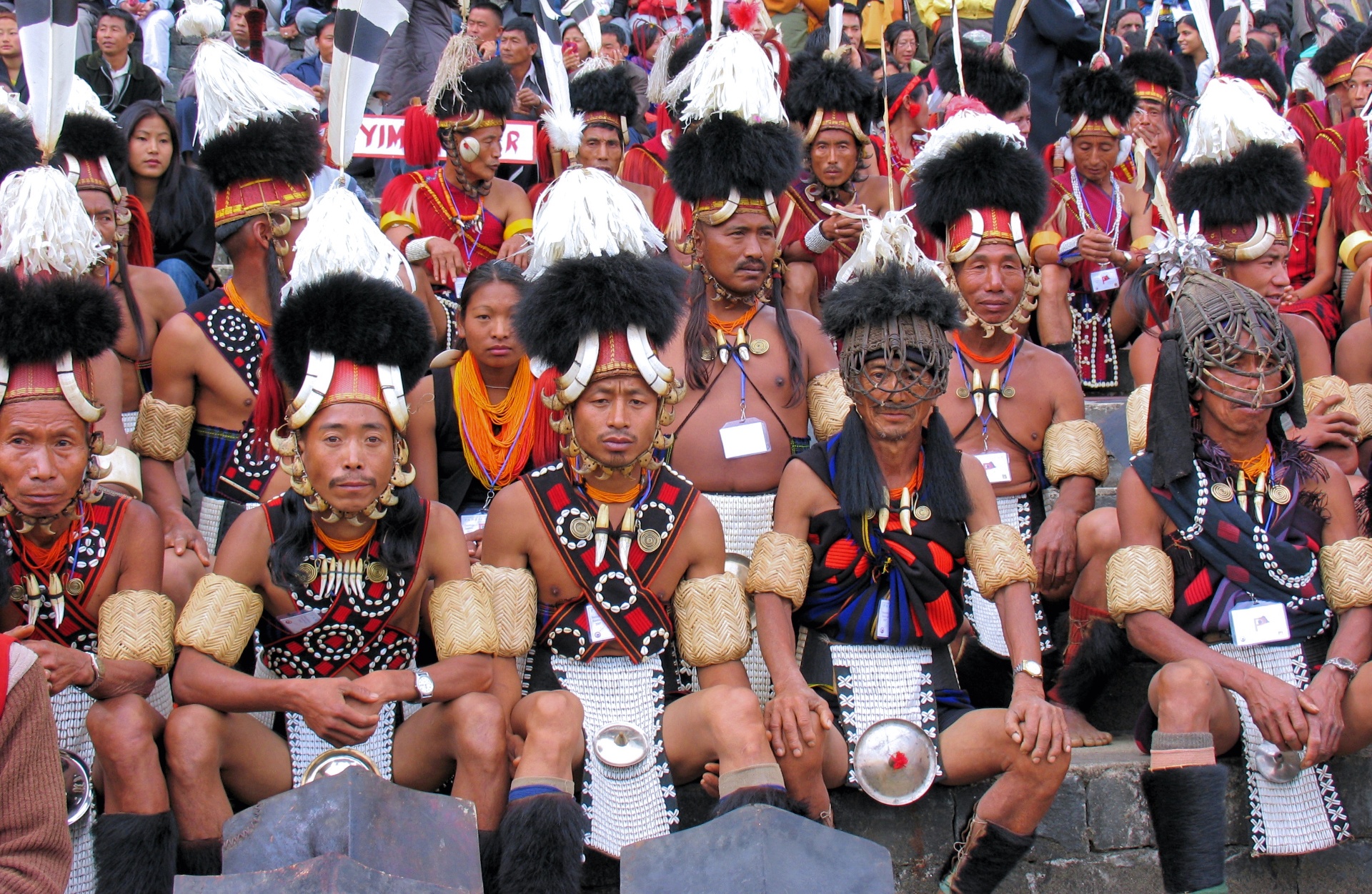
- Photograph elaborate warrior regalia and ceremonial headgear up close
- Combine ancient morung culture with a major contemporary rock festival
- Easy access from Kohima with a well-developed visitor infrastructure
04
Festival history
The festival was initiated in 2000 by the Department of Tourism and the Department of Art & Culture, Government of Nagaland, to encourage inter-tribal interaction and to keep Naga performance, dress and craft traditions visible to younger generations.
Kisama — a portmanteau of the neighbouring villages Kigwema and Phesama — was developed as a permanent venue, with a morung constructed for each major tribe so that every community could host its own performances on its own ground within the larger complex. Programming has expanded over time to include the Hornbill International Rock Contest, a literature festival, a motor rally and curated food and craft bazaars.
05
Dates and venue
- Annual dates: 1–10 December (fixed, aligned with Nagaland Statehood Day on 1 December).
- Venue: Naga Heritage Village, Kisama, ~12 km from Kohima on the Kohima–Imphal road (NH-2).
- Daily passes, schedules and Rock Contest tickets are published by Nagaland Tourism a few weeks before the festival.
06
Tribe and community
Hornbill is one of the few festivals where all of Nagaland's major recognised tribes participate together. Tribes regularly represented include the Angami, Ao, Chakhesang, Chang, Khiamniungan, Konyak, Kuki, Lotha, Phom, Pochury, Rengma, Sangtam, Sumi, Yimkhiung and Zeliang, each with a dedicated morung at Kisama.
Each tribe brings its own dialect, weaves, jewellery and dance vocabulary. The Konyak are recognisable by their tattooed elders and brass-head necklaces; the Angami for their measured warrior dances and red-and-black shawls; the Ao for their folk songs and warm striped shawls; the Chakhesang for distinctive textile bands and choral singing.
07
Cultural significance
Hornbill is a state-led cultural festival rather than a religious one. Its purpose is to keep tribal performance, dress and craft traditions in active use, to encourage exchange between Naga tribes who were historically distinct, and to anchor Nagaland's tourism calendar around a single internationally visible event.
08
Main attractions
- Tribal performances in front of each morung — warrior dances, log-drum demonstrations, courtship songs and folk theatre.
- Hornbill International Rock Contest, a national-profile band competition held at IG Stadium, Kohima.
- Naga King Chilli (Bhut Jolokia) eating contest, pork-fat eating contest and indigenous wrestling.
- Naga food court — smoked pork, axone (fermented soybean), bamboo-shoot dishes, akhuni stews and rice-beer (zutho).
- Crafts bazaar with handwoven shawls, bead jewellery, woodcarvings and traditional weapons.
- The Kohima Night Carnival — a mela-style night market and street carnival through Kohima town — and the Hornbill Motor Rally.
09
How to reach
- Air: Dimapur Airport (DMU) is the only commercial airport in Nagaland, ~75 km from Kisama. Alternatives are Imphal (IMF) and Guwahati (GAU).
- Rail: Dimapur Railway Station is the main railhead, well connected to Guwahati, Kolkata and beyond.
- Road: From Dimapur, it is a 3–4 hour drive to Kohima via NH-29; Kisama is a further 12 km on the Kohima–Imphal road. Shared taxis and pre-booked cabs operate throughout the festival.
10
Permit information
Indian nationals require an Inner Line Permit (ILP) to enter Nagaland. ILPs can be obtained online through the Nagaland ILP portal or at issuing offices in Dimapur, Kohima, Guwahati, Kolkata, Delhi, Mumbai, Shillong and Chennai.
Foreign nationals no longer require a Protected Area Permit for most parts of Nagaland but must register with the Foreigners Registration Officer (FRO) on arrival. Verify the latest rules with Nagaland Tourism and your embassy before travel.
11
Weather and best time to visit
December in Kohima and Kisama is cold and dry, with daytime temperatures typically 15–20 °C and nights dropping to 4–8 °C. Mornings can be foggy. Rain is uncommon. Pack warm layers, a windproof jacket, gloves and sturdy walking shoes.
12
Accommodation options
Kohima has the widest range of stays — hotels, guesthouses and homestays — while Kisama itself has limited options. Tourist Village tents at Kisama and homestays in Kigwema, Phesama and Jakhama provide the closest base to the venue.
Accommodation books out two to four months in advance for the festival week. Reserve early and confirm cancellation terms directly with the property.
13
Photography tips
- Best light at the morungs is in the first two hours after sunrise and again in late afternoon; midday sun is harsh.
- A 24–70 mm zoom covers most candid and group situations; a 70–200 mm is useful for stage and portrait work.
- Always ask before close portraits of elders, priests or warriors; many will pose willingly if approached respectfully.
- The Rock Contest at IG Stadium is low-light; carry a fast lens or be prepared to push ISO.
14
Nearby attractions
- Kohima War Cemetery, commemorating the 1944 Battle of Kohima.
- Khonoma Village — India's first declared green village.
- Dzukou Valley trek (overnight, weather permitting in December).
- Touphema Tourist Village for traditional Angami-style stays.
15
Festival gallery
Photographs from Hornbill Festival, shot on our own departures and by license-cleared contributors.


16
Responsible festival etiquette
Hornbill Festival is a living cultural event hosted by the All 17 recognised tribes of Nagaland community. Please attend as a respectful guest, not a spectator.
- Always ask permission before photographing elders, priests or performers.
- Dress modestly — cover shoulders and knees, especially around ceremonial spaces.
- Follow instructions from community elders and event organisers.
- Do not touch ritual objects, altars or sacred poles.
- Carry your waste back; avoid single-use plastics at venues.
- Buy directly from local artisans and homestays to support the host community.
17
Frequently asked questions
When is Hornbill Festival held?+
Hornbill Festival is celebrated in December each year at Naga Heritage Village, Kisama, Nagaland. It typically runs for 10 days (1–10 December). Exact dates vary annually — check the state tourism board nearer the date.
Which community celebrates Hornbill Festival?+
Hornbill Festival is celebrated by the All 17 recognised tribes of Nagaland community of Nagaland.
Do I need a permit to attend Hornbill Festival?+
Yes. Indian nationals need an Inner Line Permit (ILP) for Nagaland, available online at ilp.nagaland.gov.in/ilp/apply or from issuing offices in Dimapur, Kohima, Guwahati, Kolkata, Delhi and elsewhere. Following the December 2024 Ministry of Home Affairs circular, foreign nationals again require a Protected Area Permit (PAP) for Nagaland. Permit rules change from time to time, so confirm the current position with the state authority before you travel.
Where can I stay during Hornbill Festival?+
Options range from state-run tourist lodges to homestays and boutique camps. Accommodation books out months in advance for marquee festivals; reserve early.
Is Hornbill Festival suitable for families?+
Yes — the festival is family-friendly. Be mindful of crowd density on main performance days and dress modestly out of respect for community traditions.
18
Sample itinerary
- Day 1 — Arrive Dimapur, transfer to Kohima (3–4 hours). Evening walk through Kohima's main bazaar and the mela-style Kohima Night Carnival street market.
- Day 2 — Full day at the Naga Heritage Village, Kisama: tribal morungs, warrior dances and the indigenous food court.
- Day 3 — Return to Kisama for the morungs you missed; evening at the Hornbill International Rock Contest in Kohima.
- Day 4 — Drive to Khonoma, India's first declared green village; village walk with an Angami host and visit the Khonoma Nature Conservation and Tragopan Sanctuary.
- Day 5 — Early start for a day hike toward Dzukou Valley from Viswema or Jakhama; return to Kohima or onward transfer to Dimapur.
19
Plan a Hornbill Festival journey
Journeys around Hornbill Festival are planned and operated on the ground by Living Roots Expeditions, working with host families, village councils and tribal interpreters in Naga Heritage Village, Kisama. Private departures and small groups can be built around the festival days, with permits, transport and homestays arranged end to end. Tell us your dates and group size and we will send an itinerary and an approximate cost.
Prefer a form? Send a detailed enquiry →
Continue exploring
More festivals of Nagaland

Performing traditions
Folk dances of Nagaland

Travel with us
Expeditions featuring Hornbill Festival

See the full Festivals of Nagaland guide for the state-wide calendar, expeditions and travel advice.
Festival calendar
Other festivals around this time
Planning a Northeast trip in December? These festivals overlap or sit close to Hornbill Festival on the calendar.
Plan this trip
Travel to Hornbill Festival with us.
Permits, transport, vetted homestays and on-ground guides — write to us and we'll shape an itinerary around Hornbill Festival.