Nagaland · February
Sekrenyi Festival
A ten-day Angami purification festival of cleansing rituals and shared meals.
Quick facts
- Festival
- Sekrenyi Festival
- State
- Nagaland
- Place
- Kohima
- Month
- February
- Tribe
- Angami
- Duration
- 10 days (starts on 25 February)
- Best for
- CulturePhotographyHeritage
01
About Sekrenyi Festival
Sekrenyi is the festival of purification of the Angami Naga community, celebrated for ten days every February. The festival follows a fixed ritual sequence beginning with the Kizie purification on the first day and closing with reconciliation and feasting in the second week.
The principal celebrations take place in Angami villages around Kohima — Jakhama, Viswema, Kigwema, Khonoma and Kohima Village itself — and quietly draw a smaller, more committed group of cultural visitors than the December Hornbill crowds.
02
Festival highlights at a glance
- Traditional Angami purification rituals (Kizie)
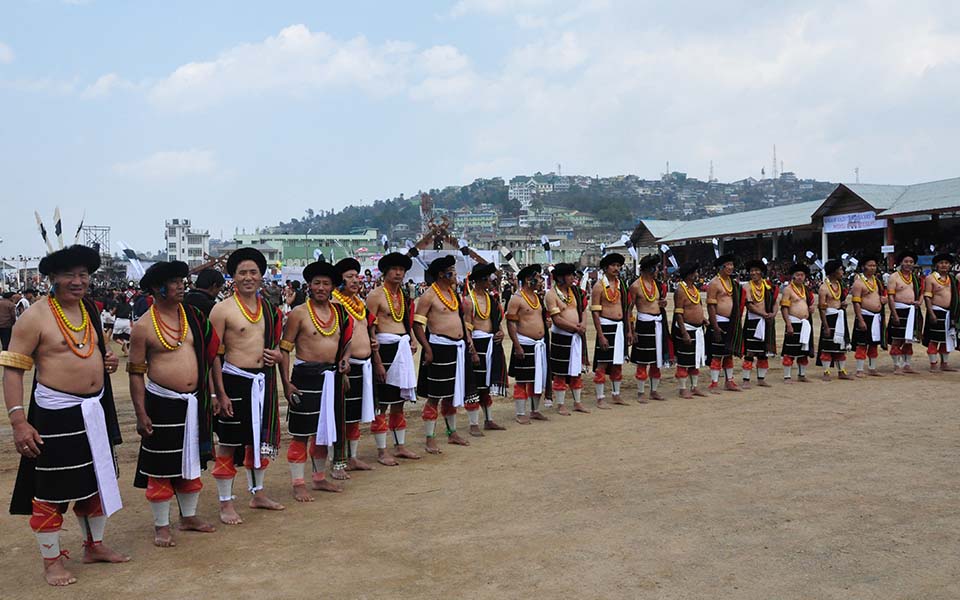
- Warrior dances performed in full Angami regalia
- Folk songs sung in call-and-response form
- Community feasts (Thekra Hie) of pork and rice-beer
- Indigenous Angami games and wrestling matches
- Men in red-and-black shawls and women in mechala skirts
03
Why visit Sekrenyi Festival?
- Experience authentic Angami traditions away from Hornbill's crowds
- Excellent cultural photography opportunities at Kohima villages
- Direct interaction with Angami host families in Jakhama and Viswema
- Witness ancient purification ceremonies still observed in full
- Easily combined with a visit to Kohima's WWII heritage sites
04
Festival history
Sekrenyi (also spelled Sukrenye or Phousanyi) has been observed by the Angami for generations as their principal community festival, marking the start of the new year and the cleansing of the previous year's misdeeds and ill-health. It is recognised as the Angami's most important festival and is gazetted in the Government of Nagaland's official festival calendar.
05
Dates and venue
- Annual dates: ten days starting on 25 February (fixed).
- Main venues: Angami villages around Kohima — Jakhama, Viswema, Kigwema, Khonoma and Kohima Village.
06
Tribe and community
The Angami are concentrated in and around Kohima and are one of the larger Naga tribes. They were historically organised into khel (territorial divisions) within each village and are known for stone-walled terrace agriculture, especially the famous terraces of Khonoma and Viswema.
Angami men wear the red-and-black tsükhu shawl with white bands; women wear the mechala skirt with a shawl draped over the shoulder. Khonoma is also notable as India's first declared green village.
07
Cultural significance
Sekrenyi is a ritual reset — a cleansing of the body, the household and the community before the agricultural year begins. The Kizie purification rite, performed by the male head of each household at the village water source, is the festival's spiritual anchor.
08
Main attractions
- Kizie purification ritual at the village water source.
- Warrior dances performed in full Angami regalia.
- Thekra Hie — community feasting and rice-beer (zutho) shared across households.
- Folk songs sung in call-and-response form by men and women.
- Indigenous Angami games and wrestling matches.
- Visits to the stone-walled terraces of Khonoma and Viswema.
09
How to reach
- Air: Dimapur Airport (DMU), ~75 km from Kohima, is the nearest airport.
- Rail: Dimapur Railway Station is the main railhead.
- Road: From Dimapur it is a 3–4 hour drive to Kohima via NH-29. Angami villages such as Jakhama, Viswema and Khonoma are 15–25 km from Kohima.
10
Permit information
Indian nationals require an Inner Line Permit (ILP) for Nagaland; apply through the Nagaland ILP portal.
Foreign nationals do not require a PAP for most of Nagaland but must register with the FRO on arrival.
11
Weather and best time to visit
February in Kohima is cold and dry, with daytime temperatures around 12–18 °C and nights dropping to 2–6 °C. Mornings can be foggy. Pack warm layers, a windproof jacket and sturdy shoes.
12
Accommodation options
Kohima offers hotels and homestays across price points. Angami village homestays in Khonoma, Jakhama and Viswema provide the closest base to the festival. Book through a Nagaland tour operator; demand is lower than Hornbill but properties are small.
13
Photography tips
- The Kizie ritual at dawn at the village water source is the most ritually significant moment — always ask the household head before photographing.
- Angami textile portraits photograph beautifully in the soft February haze; aim for early morning.
- Carry warm gear for early-morning shoots; fingers stiffen quickly in Kohima's February cold.
14
Nearby attractions
- Khonoma village — India's first declared green village.
- Kohima War Cemetery.
- Dzukou Valley trek (challenging in February — check weather).
- Japfu Peak and the rhododendron forests.
16
Responsible festival etiquette
Sekrenyi Festival is a living cultural event hosted by the Angami community. Please attend as a respectful guest, not a spectator.
- Always ask permission before photographing elders, priests or performers.
- Dress modestly — cover shoulders and knees, especially around ceremonial spaces.
- Follow instructions from community elders and event organisers.
- Do not touch ritual objects, altars or sacred poles.
- Carry your waste back; avoid single-use plastics at venues.
- Buy directly from local artisans and homestays to support the host community.
17
Frequently asked questions
When is Sekrenyi Festival held?+
Sekrenyi Festival is celebrated in February each year at Kohima, Nagaland. It typically runs for 10 days (starts on 25 February). Exact dates vary annually — check the state tourism board nearer the date.
Which community celebrates Sekrenyi Festival?+
Sekrenyi Festival is celebrated by the Angami community of Nagaland.
Do I need a permit to attend Sekrenyi Festival?+
Yes. Indian nationals need an Inner Line Permit (ILP) for Nagaland, available online at ilp.nagaland.gov.in/ilp/apply or from issuing offices in Dimapur, Kohima, Guwahati, Kolkata, Delhi and elsewhere. Following the December 2024 Ministry of Home Affairs circular, foreign nationals again require a Protected Area Permit (PAP) for Nagaland. Permit rules change from time to time, so confirm the current position with the state authority before you travel.
Where can I stay during Sekrenyi Festival?+
Options range from state-run tourist lodges to homestays and boutique camps. Accommodation books out months in advance for marquee festivals; reserve early.
Is Sekrenyi Festival suitable for families?+
Yes — the festival is family-friendly. Be mindful of crowd density on main performance days and dress modestly out of respect for community traditions.
18
Sample itinerary
- Day 1 — Arrive Dimapur, transfer to Kohima; evening at the Kohima War Cemetery.
- Day 2 — Full day at Kigwema or Jakhama for the Sekrenyi opening: Kizie purification ritual and Thekra Hie choral singing.
- Day 3 — Drive to Khonoma — village walk, the Tragopan Sanctuary edge and a meal with an Angami host.
- Day 4 — Return via Kisama (Naga Heritage Village) for the Angami morung and the surrounding Angami villages.
- Day 5 — Day hike toward Dzukou Valley from Viswema; transfer to Dimapur for departure.
19
Plan a Sekrenyi Festival journey
Journeys around Sekrenyi Festival are planned and operated on the ground by Living Roots Expeditions, working with host families, village councils and tribal interpreters in Kohima. Private departures and small groups can be built around the festival days, with permits, transport and homestays arranged end to end. Tell us your dates and group size and we will send an itinerary and an approximate cost.
Prefer a form? Send a detailed enquiry →
Continue exploring
More festivals of Nagaland

Performing traditions
Folk dances of Nagaland

Travel with us
Expeditions featuring Sekrenyi Festival


The Angami community also keeps village traditions documented on this site — Khonoma, Kohima, Kigwema, Kohima and Kohima Village (Bara Basti), Kohima. To travel to them with permits and hosts arranged, see our cultural and tribal tours in Northeast India.
See the full Festivals of Nagaland guide for the state-wide calendar, expeditions and travel advice.
Festival calendar
Other festivals around this time
Planning a Northeast trip in February? These festivals overlap or sit close to Sekrenyi Festival on the calendar.
Reh Festival
Idu Mishmi · Roing & Anini, Arunachal Pradesh
February
Wancho Oriah Festival
Wancho · Longding District, Arunachal Pradesh
February
Losar Festival
Monpa · Tawang, Arunachal Pradesh
February / March
Nyokum Yullo
Nyishi · Itanagar & Nyishi villages, Arunachal Pradesh
February
Yaoshang
Meitei · Statewide (Imphal, Bishnupur, Thoubal), Manipur
February/March
Plan this trip
Travel to Sekrenyi Festival with us.
Permits, transport, vetted homestays and on-ground guides — write to us and we'll shape an itinerary around Sekrenyi Festival.