Field journal · West Kameng, Arunachal Pradesh
Among the Monpa — a walk through Thembang, Sangti Valley and Dirang Dzong
Stone houses, inscribed mithun skulls, yak meat drying in the winter sun — three days in the Monpa heartland of West Kameng, Arunachal Pradesh.
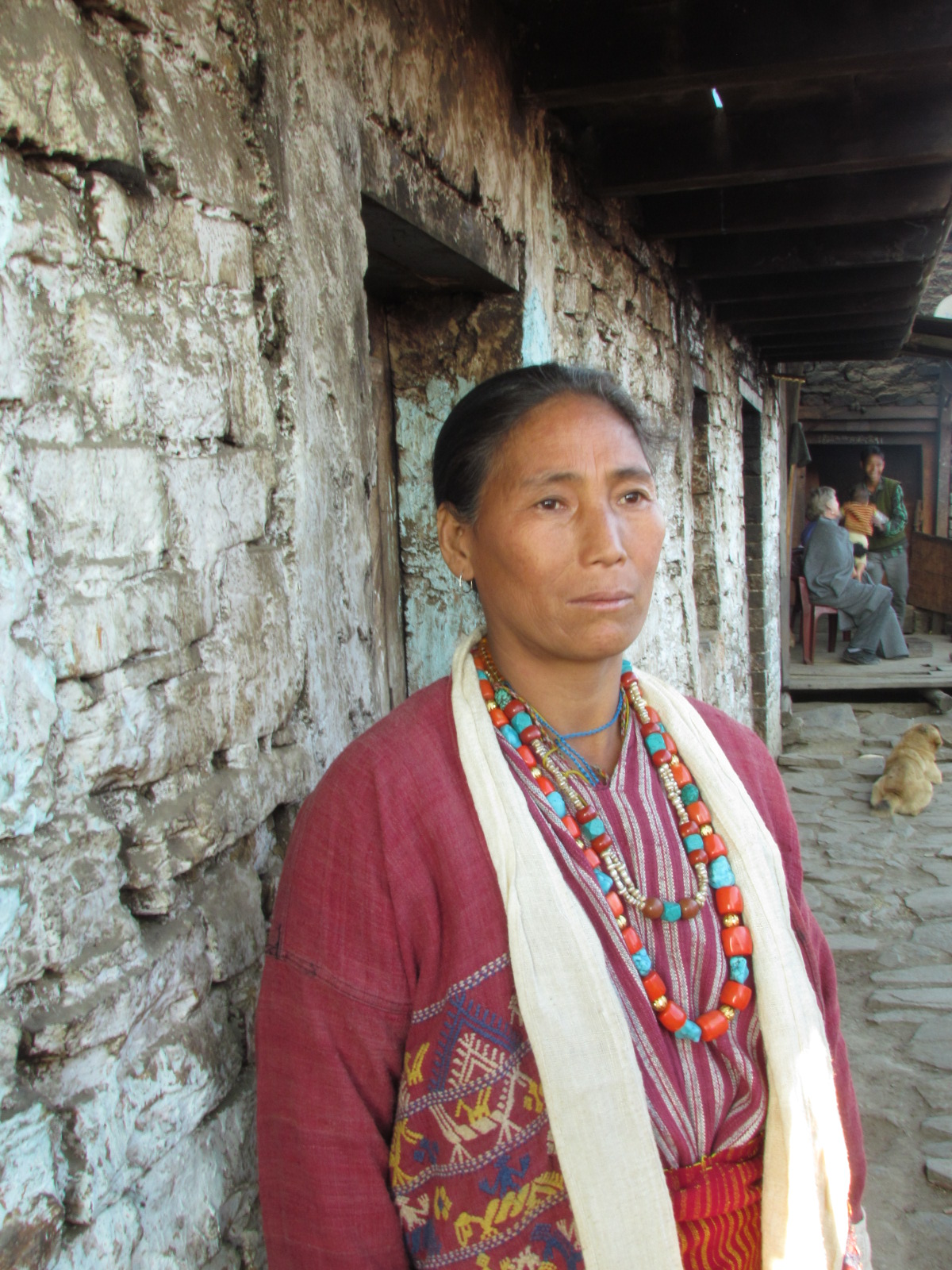
There is a moment on the road above Dirang when the valley narrows, the pines close in, and the houses stop being concrete. From there on they are stone — flat slate laid without mortar, course upon course, rising to timber eaves weighted with river boulders. You have entered Monpa country.
This is a field journal from three days spent walking the Monpa villages of West Kameng district, Arunachal Pradesh: the fortified village of Thembang, the crane meadows of Sangti Valley, the old fort quarter of Dirang Dzong, and the scatter of hamlets in between. Everything below we saw ourselves; every photograph on this page is ours.
Thembang — the fortified Monpa village
Thembang sits at roughly 2,300 m on a spur above the Dirang–Tawang road, about 45 minutes off the highway on a climbing side road. It is the only Monpa village in Arunachal Pradesh still enclosed by its old defensive wall, entered through two stone gates at the northern and southern ends — the reason it appears on India's UNESCO World Heritage tentative list as 'Thembang Fortified Village'.
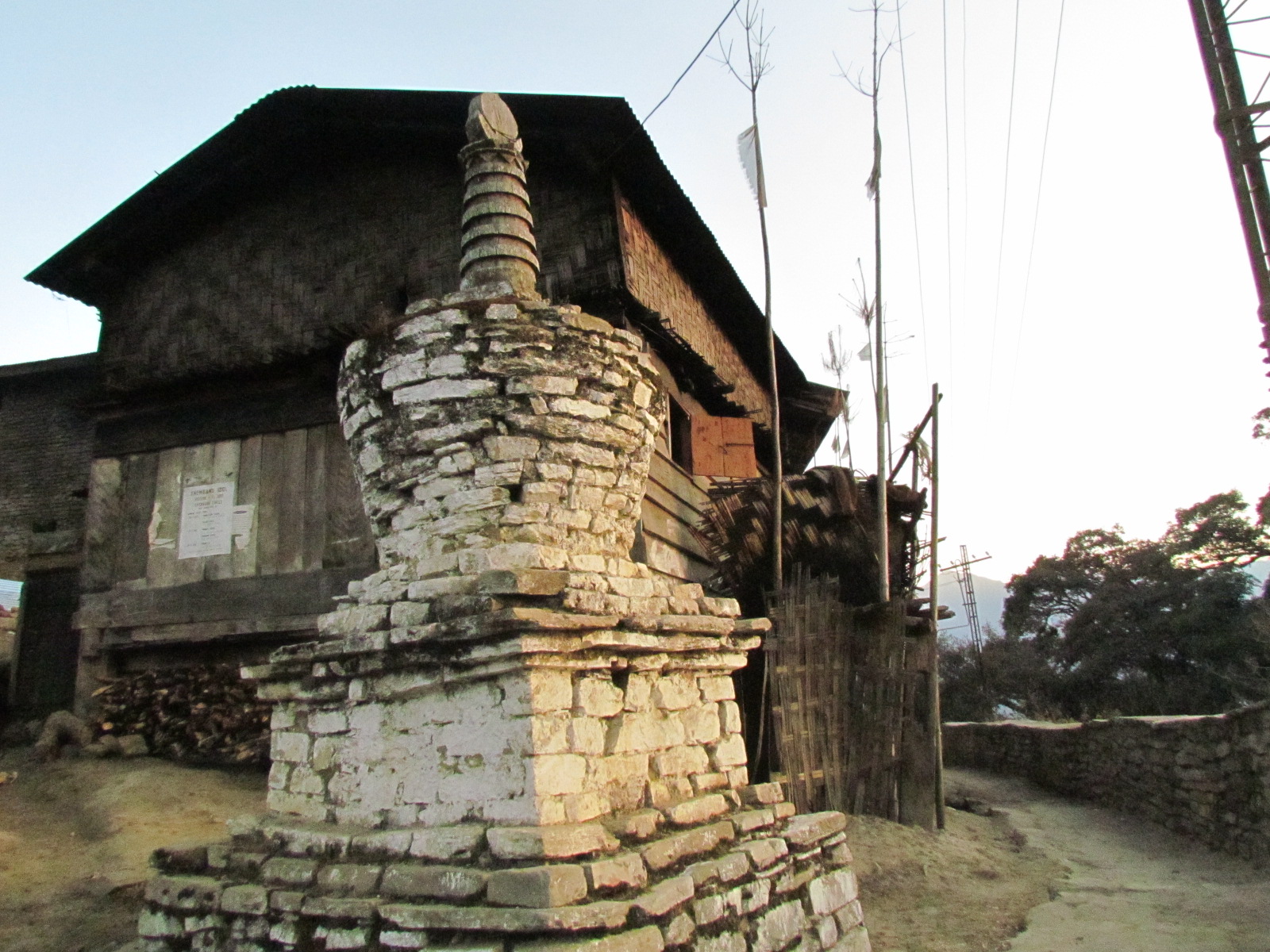
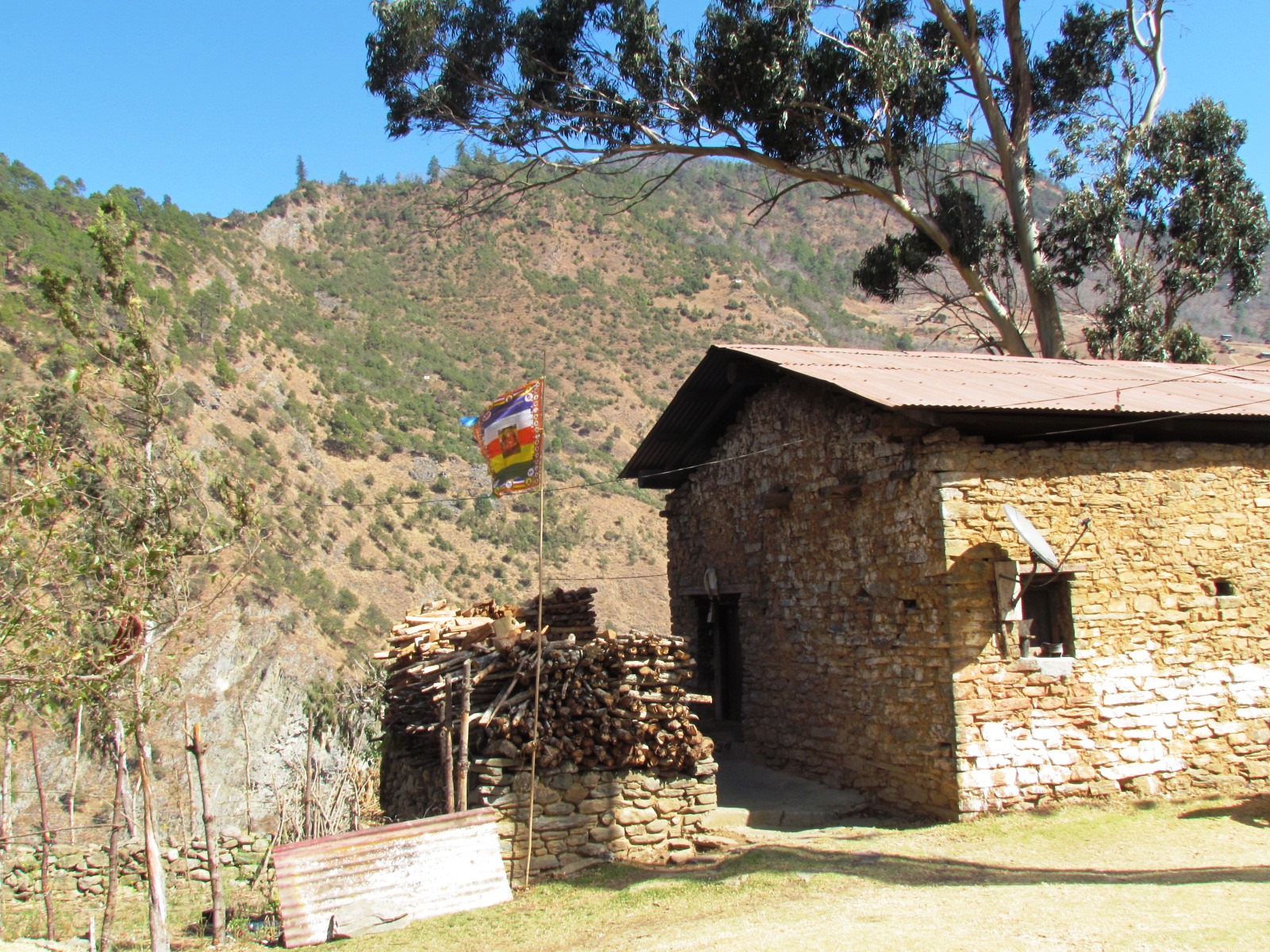
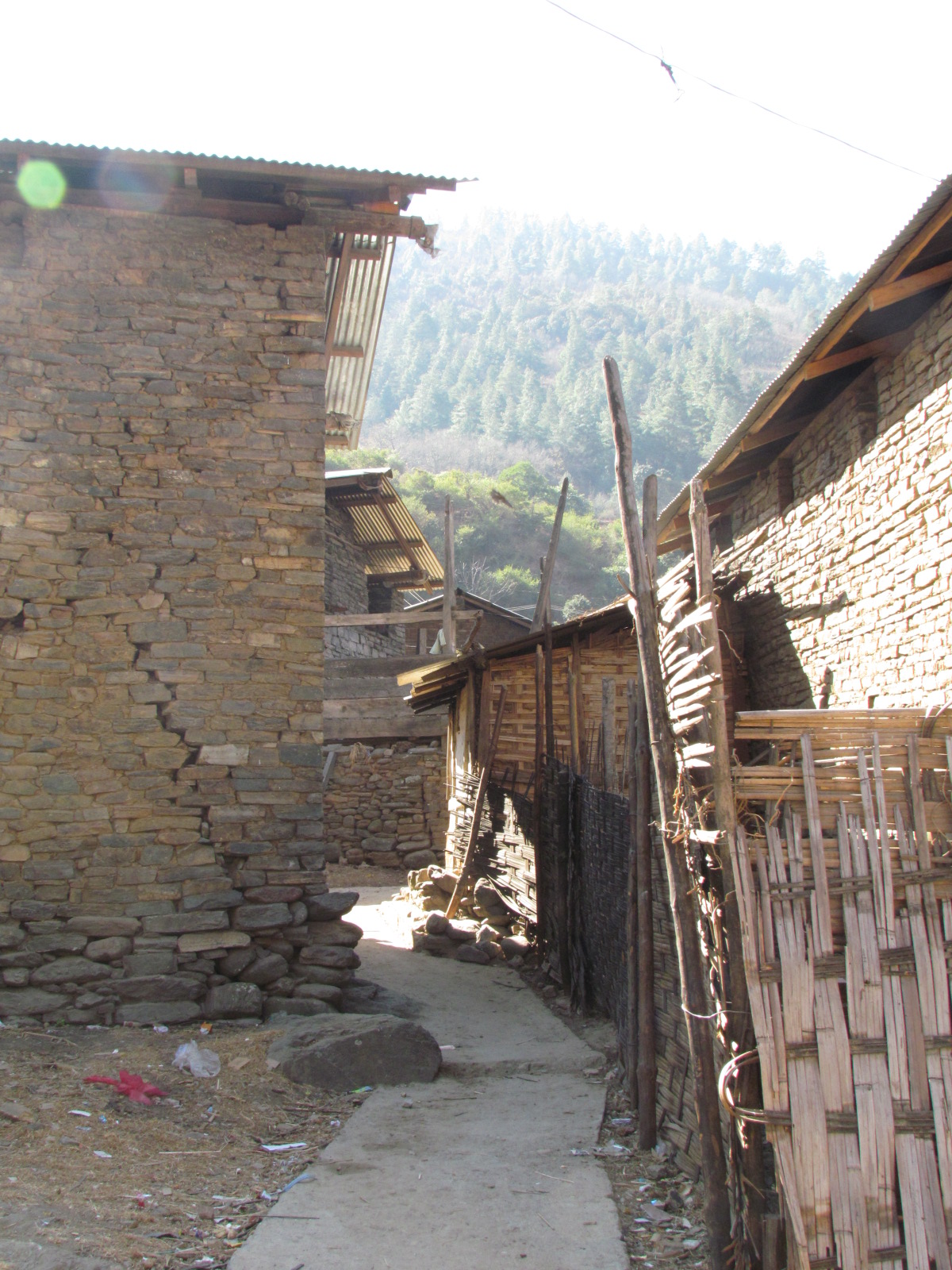
Inside the wall the village is a maze rather than a street. Lanes squeeze between two-storey houses whose ground floors once held cattle and whose upper floors hold people, hearth and altar. The walls are dry-stone; the gables are woven bamboo; the roofs today are corrugated tin over the old timber shingles, held down against the Kameng wind with anything heavy at hand.
Two clans — the Bapu and the Bardung — traditionally held authority here, and the village council still settles most local matters before anything reaches the state administration. Thembang also runs one of the earliest community-based tourism experiments in Arunachal: the Thembang Bapu Community Conserved Area, where homestays and grazing management are run by villagers themselves.
How a Monpa house is built
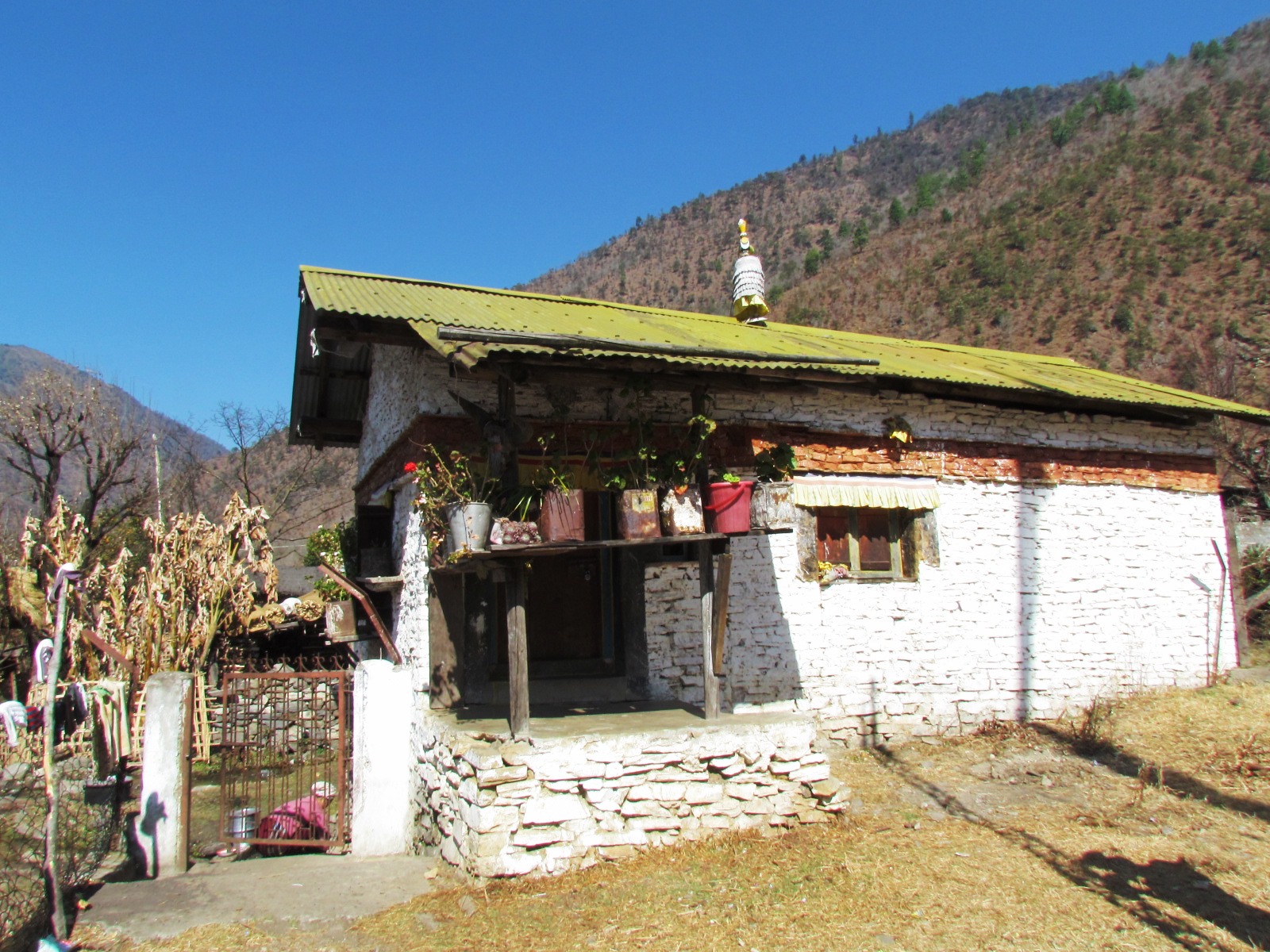
Monpa architecture is a direct answer to altitude, earthquake and cold. The lower storey is stone, thick and windowless, built without cement so the wall can flex when the ground moves. The upper storey is lighter — timber posts, bamboo matting, a small shuttered window facing the sun. Between them sits a floor of split pine on which the whole family lives.
The smaller stone huts at the edge of a compound are granaries and stores, raised on stone footings to keep rodents and damp out. We watched a woman winnowing millet outside one of them, tossing the grain in a flat bamboo tray so the husk lifted away in the cold morning draught while a goat waited hopefully at the wall.
Whitewash appears where a house has been recently blessed or where a family is better off; ochre and red bands under the eaves are a Buddhist marker, the same palette you see on the gompas at Dirang and Tawang.
The written skulls — mithun, mantra and merit
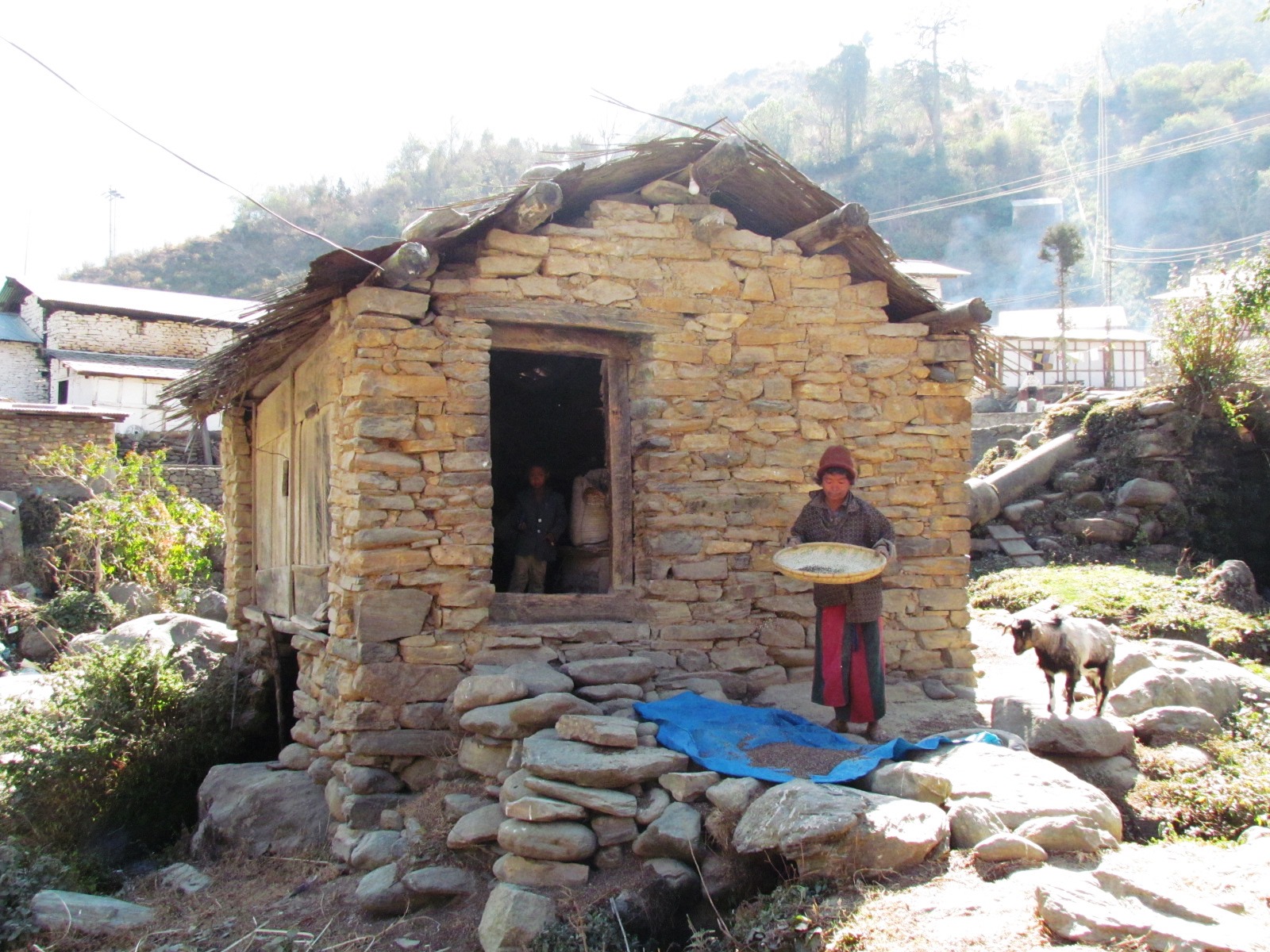
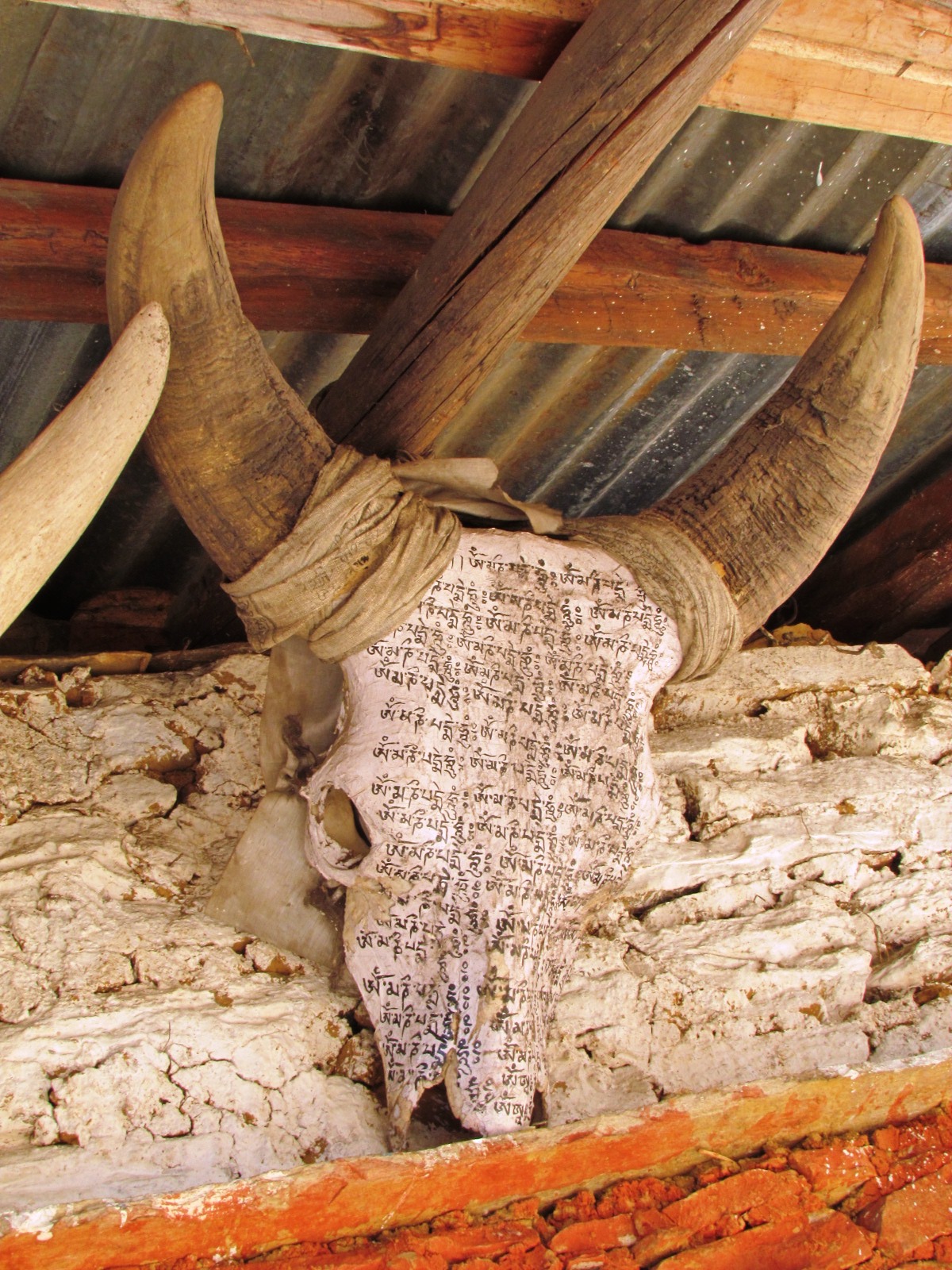
The detail that stops most visitors is above the doorways. Mithun and yak skulls are wired to the roof beams of many older Monpa houses, and their bone is covered — every flat surface of it — in tiny handwritten Tibetan script.
These are mantras, most often Om mani padme hum, written by a lama or by a literate elder of the household. The skull is not a hunting trophy in the way an outsider might read it. The animal was killed for a feast, a marriage, a funeral or a village offering, and the inscription is an act of merit-making on its behalf — a prayer that the creature's rebirth be a better one, and that the house it now guards be protected.
You will see the same practice across the Buddhist belt of West Kameng and Tawang. Ask before photographing a doorway: it is a shrine as much as a lintel.
Yak meat, chura and the winter larder
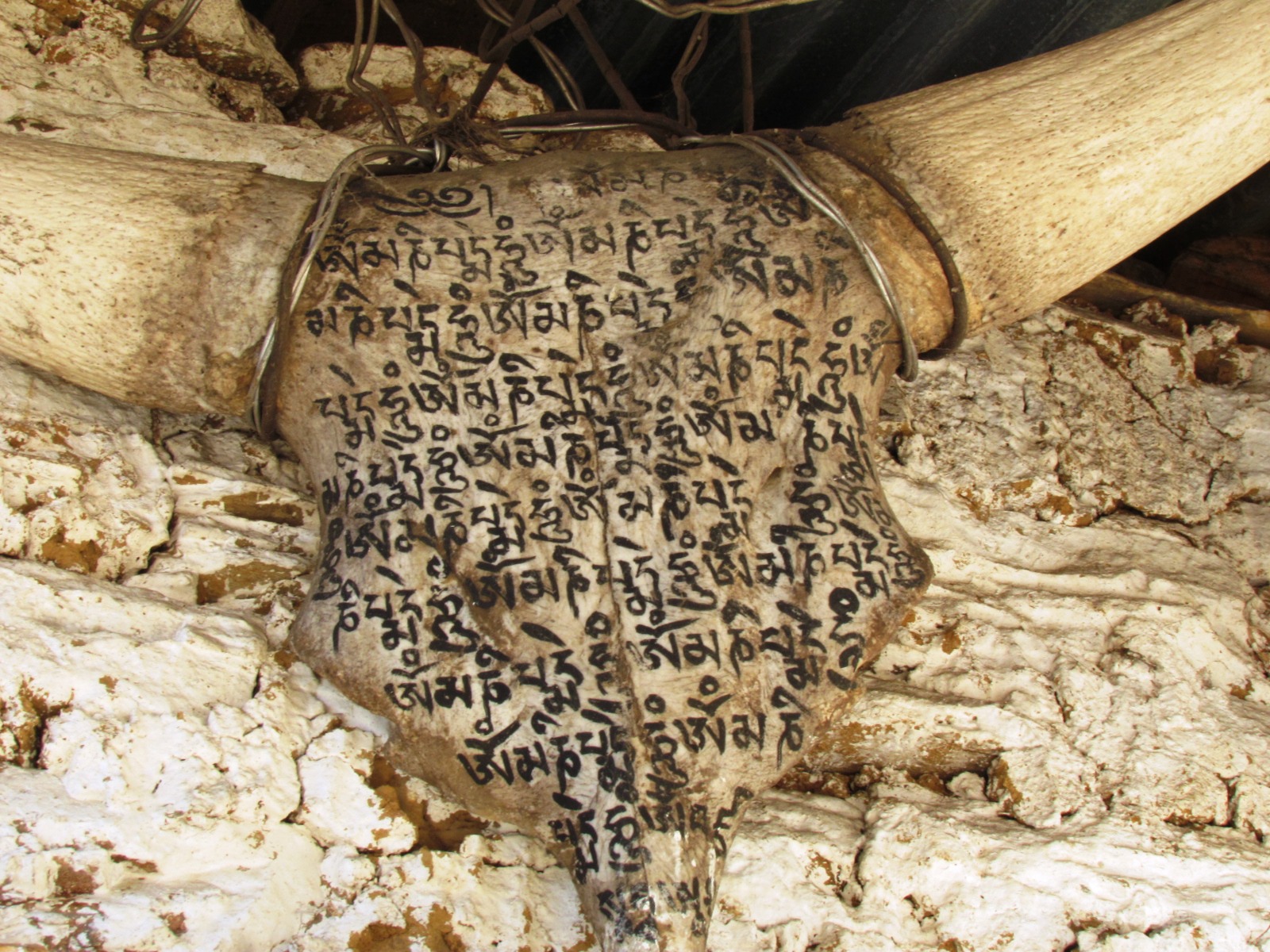
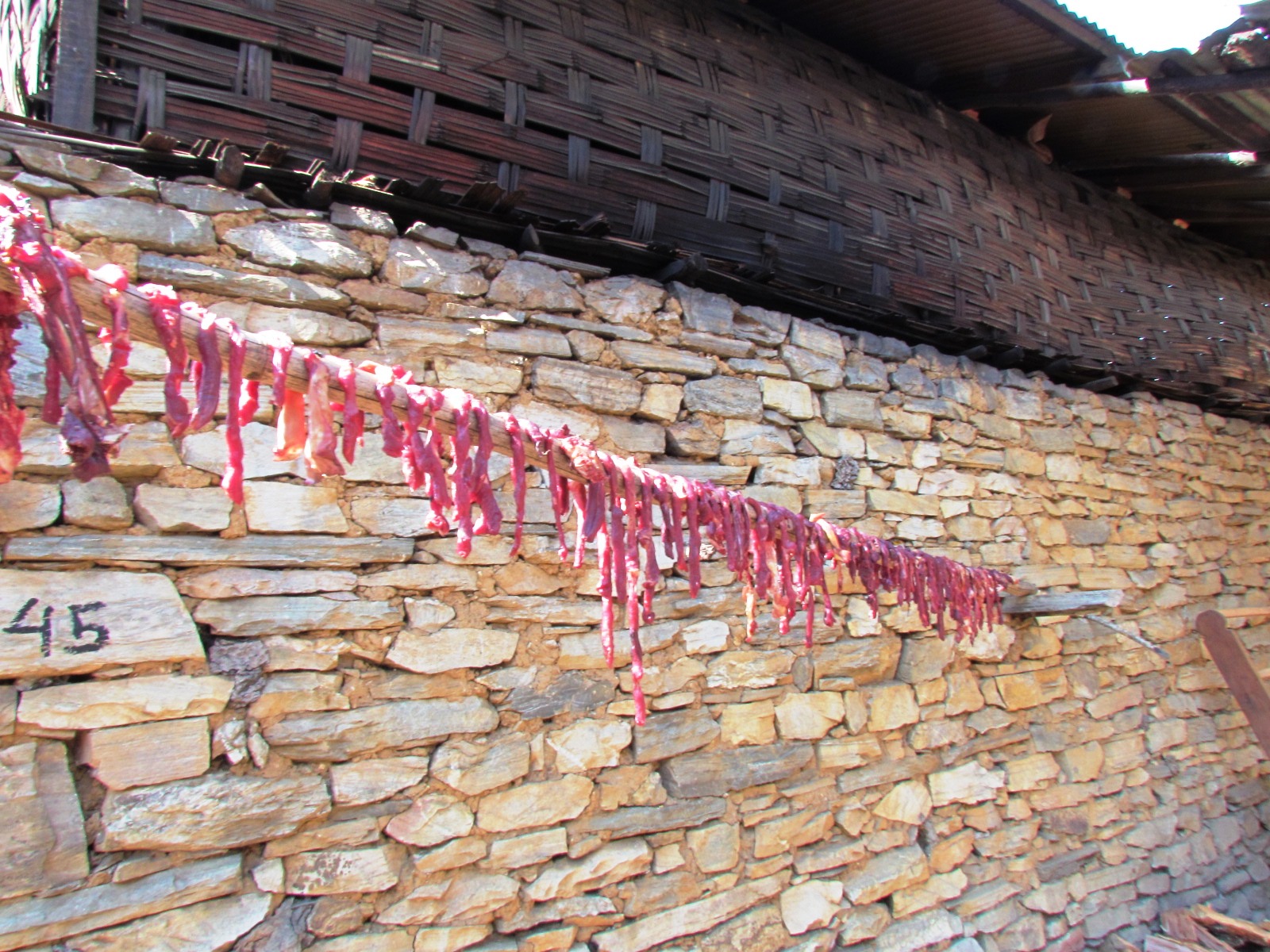
Come in December or January and the outside of a Monpa house becomes a larder. Strips of yak and beef hang on bamboo poles along the sunny wall, curing in air that is dry, thin and reliably below freezing at night. Later they are hung again above the kitchen hearth, where woodsmoke finishes the job; the result is chewed raw, or dropped into stews through the spring.
The rest of the winter kitchen runs on buckwheat, millet, maize, foraged greens and fermented cheese — chura, hard as a pebble, kept in the cheek for an hour at a time. Drinks are butter tea and a local millet or maize brew. If you are offered either, take a little; refusing outright reads as a rebuke.
Meals in a Thembang or Sangti homestay are almost always cooked on a wood hearth in the same room you sit in. That room, warm and dark and smoke-cured, is where the actual conversation of a trip happens.
Sangti Valley — cranes, apple orchards and yak pasture
Half an hour beyond Dirang the road drops into Sangti, a flat-floored glacial valley of pasture, kiwi and apple orchards and a clear braided river. It is the softest landscape in the district and the easiest walking: you can spend a whole day going nowhere in particular between hamlets, footbridges and grazing yak.
Sangti's reputation rests on the black-necked crane, a bird sacred to Tibetan Buddhists, which historically wintered here from November to February. Sightings have become rare and irregular in recent years — take any operator's guarantee with scepticism — but the valley remains superb for river birding, and the villagers' protectiveness towards the birds is genuine and worth understanding.
Most Sangti families keep a small orchard and some livestock, and several now run simple homestays. It is the natural base for a slow two-night stop between Bomdila and Tawang rather than the usual one-night highway halt at Dirang.
Dirang Dzong — the old quarter behind the new town
Most travellers know Dirang only as the hot-spring stop with a row of highway hotels. The village worth your morning is Dirang Dzong, the old settlement clustered below a 17th-century stone fort on the far bank of the Dirang Chu.
The dzong itself is a squat, high-walled fort that once served as an administrative and tax post on the trade route to Tawang; parts of it are ruinous, parts are still lived in. The lanes around it are the best-preserved stretch of traditional Monpa housing in the district after Thembang, with prayer wheels, a small gompa, and inscribed skulls over doorways.
Add the Sunday market for Brokpa yak-herders coming down from the high pasture, the National Research Centre on Yak just outside town, and the Kalachakra Gompa above it, and Dirang justifies two nights on its own terms.
The people you actually meet
The Monpa are Arunachal's principal Buddhist community, numbering around 60,000 across West Kameng and Tawang districts, following the Gelug school and speaking a cluster of Tibeto-Burman languages — Tawang Monpa, Dirang Monpa, Lish, Bhut — that are not always mutually intelligible from one valley to the next.
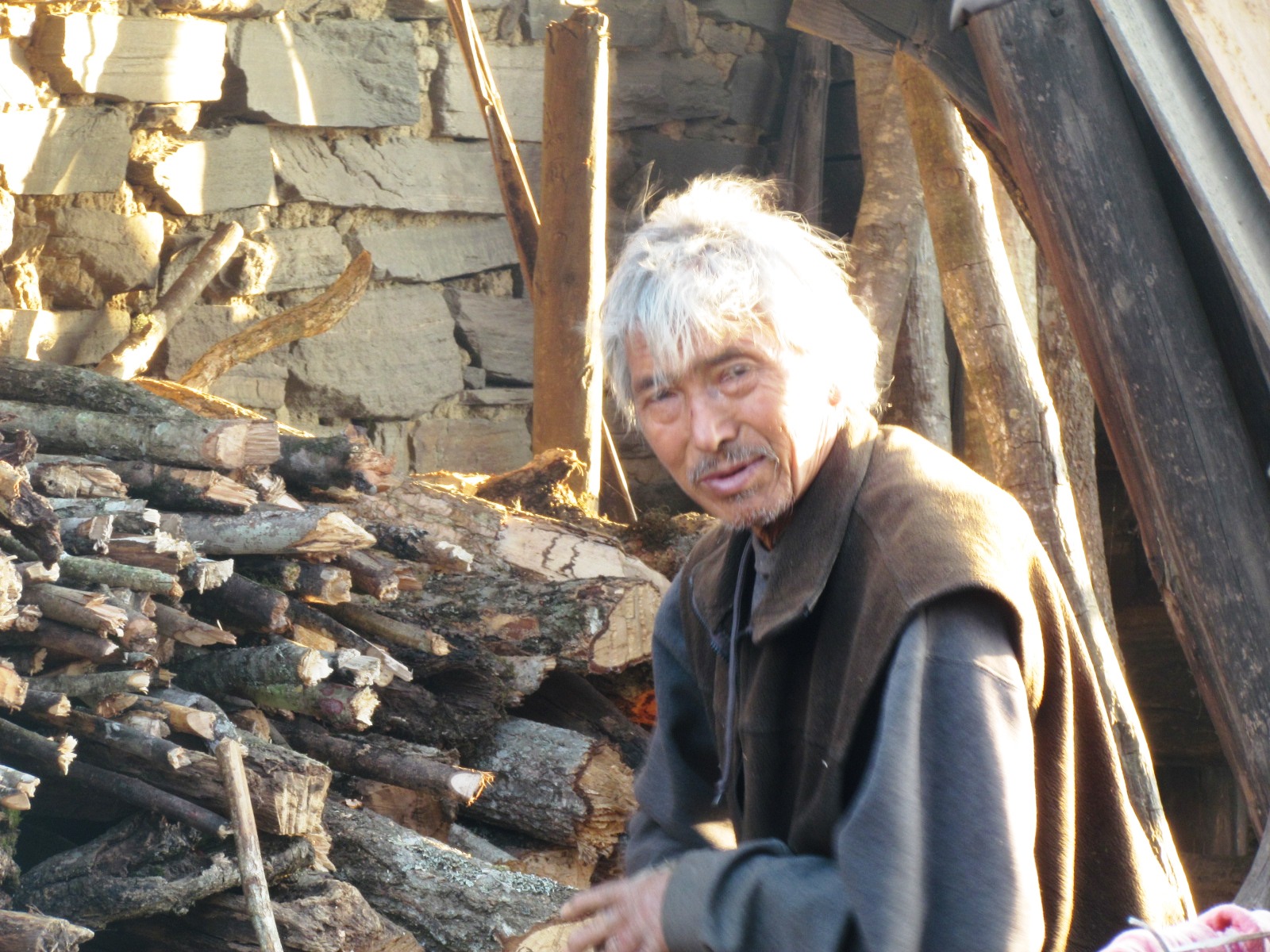
In the villages you will meet elders in maroon woollens splitting pine for the winter, and women wearing striped hand-loomed jackets with coral and turquoise necklaces — old family pieces, not market goods. Hindi works in the towns; in the villages a local guide is what turns a photo-stop into a conversation.
Two courtesies matter more than any other. Ask before you photograph a person or a doorway shrine. And walk clockwise around chortens, mani walls and prayer wheels — it costs you nothing and it is noticed instantly.
How to plan the same trip
The circuit is straightforward: Guwahati or Tezpur to Bomdila (7–9 hours by road over Sela's foothills), Bomdila to Dirang (1.5 hours), and Thembang or Sangti as day trips or overnight stops from there. Continuing north to Tawang over Sela Pass adds two more days and is worth it.
Permits are compulsory. Indian nationals need an Inner Line Permit (ILP) for Arunachal Pradesh; foreign nationals require a Protected Area Permit (PAP), issued for a minimum group of two and arranged through a registered operator. Neither is difficult, but neither can be arranged at the gate.
The best window is October to April: clear skies, hard light and the drying-meat, wood-smoke rhythm of winter village life. Roads are open but cold, and Sela can close briefly after snow. Monsoon (June–September) brings landslides and is best avoided on this road.
- Best months: late October to mid-April; November–February for full winter atmosphere
- Base: Dirang (2 nights) plus a homestay night in Thembang or Sangti
- Getting there: fly to Guwahati or Tezpur, then road via Bhalukpong and Bomdila
- Permits: ILP for Indians, PAP for foreign nationals — arrange in advance
- Altitude: Dirang 1,560 m, Thembang ~2,300 m, Sela Pass 4,170 m
- Carry: down layer, torch, cash — ATMs are unreliable beyond Bomdila
Frequently asked questions
- Who are the Monpa people of Arunachal Pradesh?
- The Monpa are the main Buddhist community of West Kameng and Tawang districts in Arunachal Pradesh, numbering roughly 60,000. They follow the Gelug school of Tibetan Buddhism, speak Tibeto-Burman languages that vary valley to valley, and are known for stone-and-timber architecture, yak herding, hand-loom weaving and handmade paper.
- Why is Thembang village famous?
- Thembang is the only Monpa village in Arunachal Pradesh still enclosed by its original defensive stone wall with north and south gates. It is on India's UNESCO World Heritage tentative list as 'Thembang Fortified Village' and runs a community-managed conservation area with village homestays.
- Why are mithun and yak skulls written on in Monpa houses?
- Skulls of animals killed for feasts or rituals are mounted on house beams and inscribed with Tibetan mantras, usually Om mani padme hum. The writing is an act of merit-making for the animal's rebirth and a protective blessing for the household — the skull is a shrine, not a hunting trophy.
- Can you still see black-necked cranes in Sangti Valley?
- Black-necked cranes historically wintered in Sangti Valley between November and February, but sightings have become rare and irregular in recent years. Treat any guaranteed sighting with caution; the valley is still excellent for general river birding and easy village walking.
- What permits do I need to visit Dirang, Thembang and Sangti?
- All visitors need a permit for Arunachal Pradesh: Indian nationals require an Inner Line Permit (ILP), and foreign nationals require a Protected Area Permit (PAP), issued to groups of at least two and arranged through a registered tour operator in advance.
- When is the best time to visit the Monpa villages of West Kameng?
- Late October to mid-April. Winter months from November to February give the clearest mountain views and the most atmospheric village life — drying meat, wood smoke and hearth cooking — while the monsoon from June to September brings landslides on the Bhalukpong–Bomdila road.
Photo gallery — from the same trip
More from the journal
Aoleang Festival, Mon — Where the Konyak New Year Comes Alive
Six days of spring in Mon district, when the Konyak lay down the old year, put on their fathers' headgear and dance the new one in.
Majuli Island, Assam — crossing the Brahmaputra to a river island
The ferry ghat, an hour on the Brahmaputra, and then paddy fields — notes from Majuli, the river island at the heart of Assam's Vaishnavite culture.